



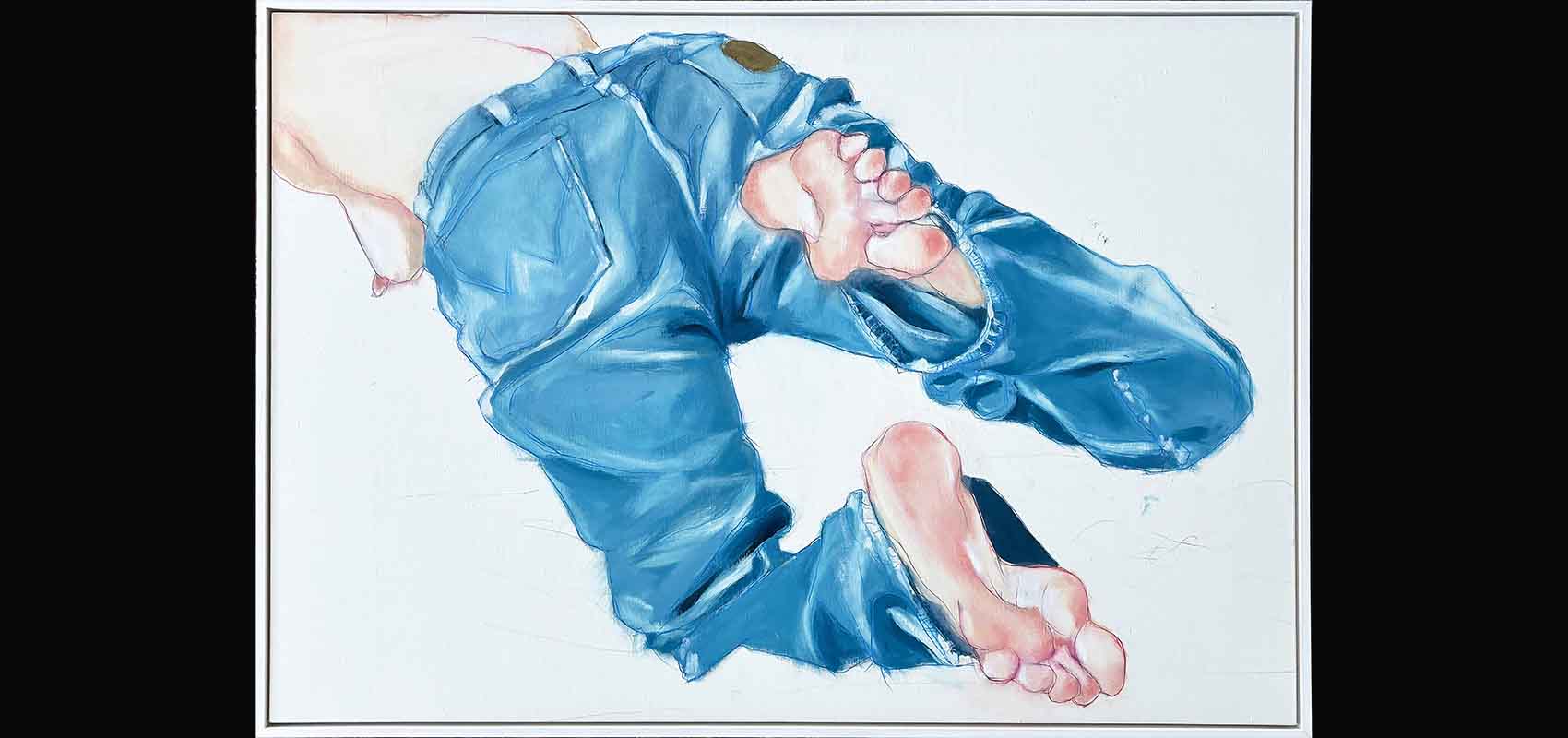
The concept of beauty has always eluded Luella Bartley. It’s something she can’t quite understand from close up, and that’s all the better for the rest of us.
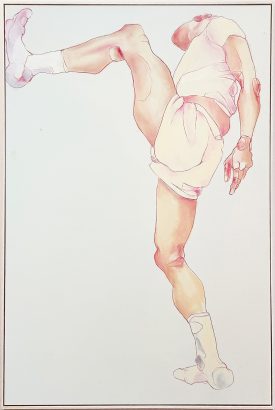
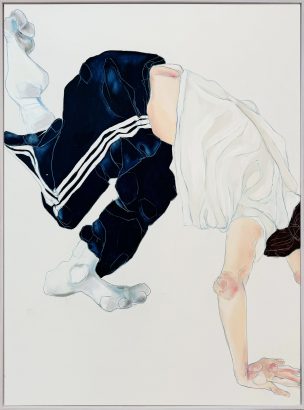
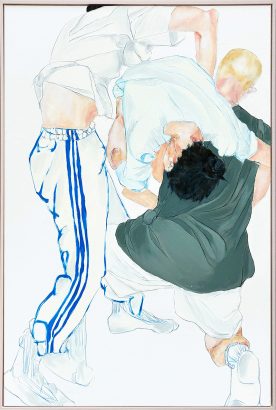
In her home studio in London, Bartley’s walls are adorned with drawings and half-finished paintings of figures that are stuck in time yet fluid in motion. Limbs and torsos bend and contort in molten positions, outlines run their course with no course in mind.
In a Luella Bartley painting, nothing is quite correct. That’s exactly how she likes it. “Too good, too proper, and I lose interest,” she says. Like her work, Bartley’s voice carries a shrugging kind of candor. It resembles that of youthful rebellion but it is in fact the sort that comes from a life thoroughly lived and accepted, even if reluctantly.
For the majority of people who know her name, Bartley, 50, is most recognized for her work in fashion—she’s the wunderkind designer who helped shape the British fashion scene in the early 2000s. She spent a few years working in journalism as both a writer and editor for U.K. publications such as British Vogue and the London Evening Standard, continuing her fashion education at Central Saint Martins. By the late Nineties, she’d launched her eponymous label, Luella. It wasn’t long before she was designing an It bag for the luxury leather goods brand Mulberry.
In 2010, she was awarded an MBE by the Queen for her contributions to the fashion industry. Bartley became a stalwart totem of London cool, designing pieces that homed in on a specific kind of messy, mischievous girlhood. In 2015, she launched the Hillier Bartley label in partnership with the accessories designer Katie Hillier, after two years of designing for Marc by Marc Jacobs.
“I don’t think the paintings are about grief. Not linearly. But they couldn’t exist without it. You know, there’s a life before and there’s a life after.”
To Bartley, though, most of that has felt quite detached from the work she’s doing now. At least, it did until recently. While her earlier paintings were mostly of nude figures, her recent pieces have embraced the depiction of at least some clothing. “I think at the beginning of my painting practice, it was really about stripping it down, and now I don’t feel like that so much anymore,” Bartley explains. Today she feels it would be silly to disregard or look down upon the nearly three decades she spent in fashion: “I see now that all these things, all the experiences I’ve had in my life, are important.” Because even a rejection of the past is an admittance of its occurrence, isn’t it?
And her past is something that’s particularly hard to evade. Rarely does a write-up about Bartley’s art avoid mentioning the fact that her life was dramatically changed in 2021, after she and her husband, the photographer David Sims, lost their son Kip to leukemia when he was 18 years old.
Bartley admits that before our interview she had told herself she wouldn’t discuss this tragedy that has marked her life forever. But she couldn’t help but bring Kip up before I’d had the chance to ask. The impact of his passing, even if not the sole cause of everything, is irrefutable. “I don’t think the paintings are about grief,” she says. “Not linearly. But they couldn’t exist without it. You know, there’s a life before and there’s a life after.”
After the trauma of her son’s death, Bartley says her reaction was to freeze. Making art offered her some form of movement, particularly a solitary one. A way to carry on being without needing to be with others. “Painting was a way of doing something without doing something. A way of connecting to myself and my feelings without connecting to the world,” she says.
There is a long, quiet tradition of women artists whose work emerges in the aftermath of rupture. Bartley has just finished reading The Baby on the Fire Escape, a book by Julie Phillips, in which the author writes that “motherhood and art are both total acts of attention.” For women, particularly mothers, the act of making art has often meant reclaiming a private inner space in a world that demands outward performance. Bartley has two other children, and she is quick to note that caring for them remains her “primary job.” But painting, she says, has become a parallel form of care—for herself, for her memories, for whatever it is that lives just beneath language.
“If I was truly going to bare my soul, maybe I’d be writing,” she concedes. “And I don’t know, because what I’m doing with painting is, actually, I’m teaching myself. I’m trying to learn how to paint as well as trying to untangle my feelings.”
Until then, though, Bartley is doing just fine communicating without so many words. Previously her solo show at Kristin Hjellegjerde in West Palm Beach, Florida, which followed exhibits in Berlin and Chicago. Through her paintings you get the feeling that the artist is making sense of something that little sense can be made of. While working with her life model, Esther, the first few times, Bartley says she recognized Esther’s ease in her own body that had first struck her as aspirational. “She was very different from how I felt,” Bartley says. “Maybe how I wanted
to feel.” While the paintings are beautifully done, they depict a beauty that is almost expressly denying the parameters of aesthetic correctness.
Bartley says she’d start by drawing based on photographs of her model, but the figures she’d create would end up having to morph into something uncanny. “They sort of were too beautiful,” she says. “So I would enlarge things. I would distort things. And I would put my feelings about female form in that weren’t necessarily real and actually make them more ugly. Maybe that’s just how I was feeling at the time.” But maybe that would be reading into it too much. “It could be just as simple as I really love drawing big feet!”
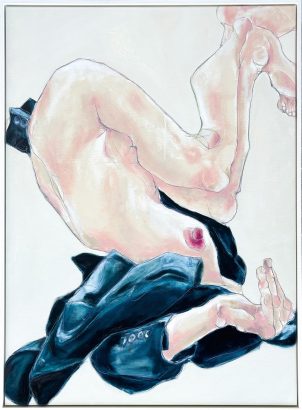
Bartley’s work, before and now, has always been about resisting conformity. Even being an artist is an act of drawing outside the lines delineated for a mother, or for a professional in the creative industry. “The great thing about painting—for me, anyway—is that nothing is intentional,” she says. “You don’t sit down the way you do when you start a collection and you build this kind of idea and narrative. The nice thing about painting is that it’s all intuition, and you actually don’t know what you’re doing until you’ve done it.
“You just sit and watch telly and you can’t fucking cope with anything. And then other times you can turn it around and go, you know, ‘Okay, get your ass up and try to make something of it.”
“But gosh, you can do something you’re so proud of, then fuck it up in a minute, and you can’t then go, ‘Oh, it’s fine, I’ll just cut and paste that and do that,’ you know. You have to do it again completely from scratch. And it’s a very, very slow, frustrating process. But I do kind of like that.”
Challenging, sure, but the craft is also meditative. Bartley likes that painting, like living, can’t be rushed. It requires presence, patience. Sometimes, though, “you just sit and watch telly and you can’t fucking cope with anything. And then other times you can turn it around and go, you know, ‘Okay, get your ass up and try to make something of it.’”
Bartley tells me that returning to fashion recently—quietly, for now—has felt surprisingly nice. Not because she necessarily missed the industry, but because she no longer feels confined by its rules. “There was a time when if you were a fashion designer, that was it. You couldn’t be anything else. But I don’t think that holds anymore.”
She can’t tell us what she’s up to in that realm just yet, but she expresses an excitement for her current passion for painting to be able to complement her work in the fashion world. Back in 2023, Bartley told the U.K.’s Guardian that she had no plans to return to fashion, but that she wouldn’t rule it out, noting that she loves Raf Simons and the art director and graphic designer Peter Saville, both of whom she worked with while at Calvin Klein from 2017.
The art world can be notoriously suspicious of crossovers, just as the fashion world once was. But Bartley isn’t too keen these days on staying in anybody’s predetermined lane. If anything, she’s stepping sideways.
Virginia Woolf famously argued that “a woman must have money and a room of her own if she is to write fiction.” Bartley, painting alone in her studio, is writing a story of images that she doesn’t quite know how to read yet, and she doesn’t really need to. She may not be totally free from the rest of the world, but at least she’s found a quiet place to renegotiate her terms with it. As she describes her practice, it’s sometimes hard to tell if Bartley is talking about her art or about something greater, something deeper. Maybe it’s foolish to try to distinguish between the two. “I don’t think I’ll ever feel finished,” she says. “But maybe that’s the point. You just keep going.”
By Ludwig Hurtado.
Homepage image: Transference,2024 Oil and pencil on canvas, 130 x 90 cm. Top left, Acceleration, 2024 Oil and pencil on canvas, 150 x 100 cm; top right Astronaut,2024 Oil and pencil on canvas, 135 x 100 cm. Bottom left, Transmission,2024 Oil and pencil on canvas, 135 x 90 cm, bottom right; Head over Heels, 2025 Oil and pencil on canvas, 130 x 95 cm. This article first appeared in Mission’s Women Of Today issue, Spring Summer 2025.