


When Shirin Neshat left Iran, she couldn’t have known that the country she once called home would soon experience a radical shift that would affect its citizens to this day.
At a time when she was no longer pursuing a career in art, the lasting effects of the Iranian Revolution suddenly gave her focus; amid the tribulations of the country—specifically the women of the country—Neshat saw clearly the plight of humanity in its endless tussle for freedom. Fear, dominance, resignation, inevitability, vulnerability, defiance; these characteristics show up in her subjects time and time again beneath pointed political messages and haunting, poetic imagery—and it’s those qualities that have made her oeuvre feel as relevant now as it has been in decades past.
Since her breakthrough in the early ’90s, Neshat has had an exemplary career. Among a much longer list, she’s been included in the Venice Biennale (1999) and the Whitney Biennial (2000), is part of the permanent collection at the Los Angeles County Museum of Art, and in 2019 she had a 30-year retrospective show at Los Angeles’s Broad Museum. Her output primarily revolves around still photography and filmmaking, the latter ranging from short films on loop at galleries to feature-length films that have premiered at festivals including the Tribeca Film Festival and the Venice Film Festival (where she won the Silver Lion award for her feature film Women Without Men).
Though the topics in her work largely revolve around Iranian politics and the experience of Iranian women, Neshat is open about the degree to which her work sits between a Western and Middle Eastern perspective. “I have to stress that I’m an Iranian woman who has lived outside [of Iran] since I was 17,” she says. “And so even though my Iranian background is heavily emphasized, I would really say I’m a true New Yorker.”
That fact is important when assessing her work and the perspective behind it. Neshat was raised in the city of Qazvin, and while she didn’t grow up around art, she always held the notion of becoming an artist. In 1975 she moved to California to study at Berkeley, earning her bachelor’s and master’s degrees. She moved to New York in 1983 but by then had given up her pursuit of art. Instead she would spend the next decade of her life working at the not-for-profit Storefront for Art and Architecture, becoming codirector alongside her then-husband, Kyong Park, who founded the organization. There she was exposed to the rousing New York art scene, where high concepts flourished. She attempted to create art during this time, but she hadn’t yet found the source of inspiration that could drive her motivation and produce something worth standing by.
“I have to stress that I’m an Iranian woman who has lived outside [of Iran] since I was 17. And so even though my Iranian background is heavily emphasized, I would really say I’m a true New Yorker.”
Throughout this period, Iran had gone through its own pivotal shift. The 1979 Iranian Revolution placed Ayatollah Khomeini in charge of the Islamic Republic, which still maintains control of the government to this day. Suddenly the country transformed into a theocracy in which traditional values replaced the modernity it was moving toward. The consequences were dramatic in both the political and cultural spheres; among those was implementing the mandatory hijab for women, the very change driving the protests in Iran today.
When Neshat finally visited Iran in 1990, she was returning to a country that was culturally unrecognizable to her, having grown up in a vastly different Iran and having immersed herself in the culture of the U.S. “As a person who really was homesick for her home and her country, I just felt the urge to reconnect on a deep personal level.” she says. She visited in the ’90s, but she’s quick to point out how her perspective had changed by then, as she was experiencing a personal transformation informed by her life in New York. “My return to Iran was from the point of view of an Iranian who had been away for 11 or 12 years” says Neshat. “And meanwhile there had been the revolution, the war with Iraq, and the breakdown of the diplomatic relationship with the U.S. But for me, it was graduating from school in Berkeley, coming to New York and being exposed to the underground art scene, and working at a not-for-profit gallery. It was a really fascinating period in my life, so you have to consider my experience.”
Her return provoked something deep inside as she sought connection with a country that now felt unfamiliar. “I [wanted] to be reconnecting to Iran. And for me, like most people who have been away, suddenly the nostalgia may come to an end,” she says.“So the art became a tool, or a way to continue this relationship that had been lost for many, many years.” Her approach to art had also shifted since she had been exposed to groundbreaking conceptual artists of the time including Nam June Paik, Bruce Nauman, Vito Acconci, Kiki Smith, and Alfredo Jaar. “At the beginning in New York I was really fascinated by Cindy Sherman, for example, who was taking pictures of herself and doing these impersonations of different characters, which I think unconsciously let me do The Women of Allah, which I performed myself, and I played the roles of other women.” says Neshat.
“At the beginning in New York I was really fascinated by Cindy Sherman, for example, who was taking pictures of herself and doing these impersonations of different characters, which I think unconsciously let me do The Women of Allah, which I performed myself, and I played the
roles of other women.”
The Women of Allah (1993–1997) would become one of Neshat’s most famous works. The series depicts the duality of Iranian women with stark, sometimes confrontational black-and-white images of veiled women (portrayed by Neshat). They often have serene expressions, sitting beside or holding guns, with Farsi poetry emblazoned on themselves in calligraphy. Between the thematic complexity and emotional depth, Neshat had found her artistic voice, and a spellbound audience. “For the longest time I didn’t really have a methodology, but once I found my subject, I was able to then create my own language and signature,” she says.
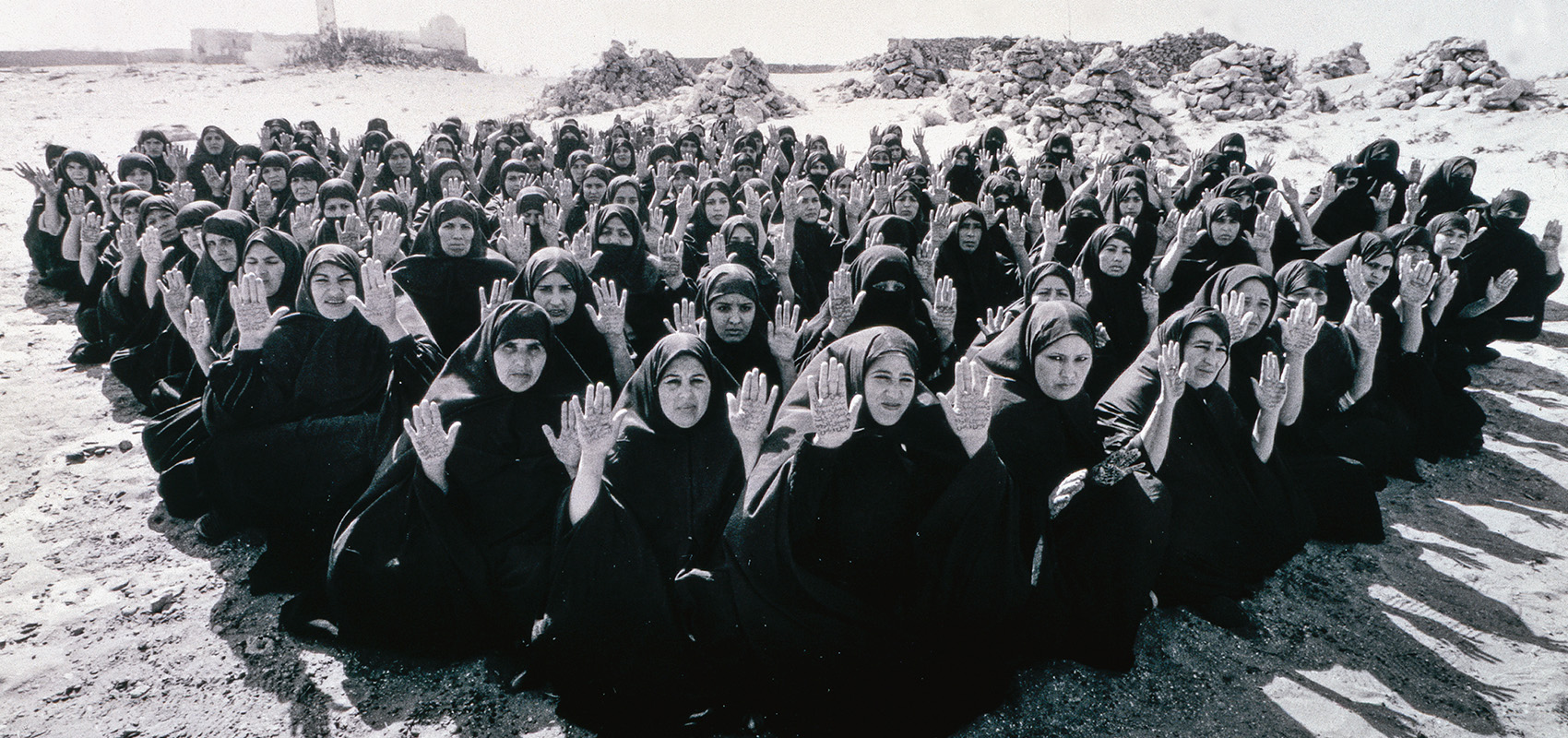
Those signatures would show up in later works, including stark black-and-white portraiture (On Guard, 1998; The Fury, 2023). Her short films often use surreal and dreamlike visuals as a backdrop for stirring expressions of identity within a place (Rapture, 1999; Roja, 2016). While many of the scenes she creates have a poetic quality to them, she frequently uses poetry directly on subjects to build on the abstraction inspired by conceptual artists but also to subtly comment on the duality between Iranian and Western cultures. (“One thing about poetic language, especially from Iran, where we have censorship and years and years of dictatorship, you know, people have learned very well to say everything between the lines,” says Neshat.)
Though much of Neshat’s work is assessed for its political message, it’s as much an exploration of the universal themes of gender and identity informed by her own life. “Since the inception of my work, women have become the core of my work,” she says. “I’ve known, for example, how unconsciously I have gravitated toward women writers, women poets.” One poet that has been a major influence and has had recurring appearances in Neshat’s work is Forugh Farrokhzad, an influential figure in Iranian art who brought the female perspective to the forefront before her untimely death in a car accident at 32. “She lived a very complicated life,” says Neshat. “And so for me, beyond her incredible poetry, she became an idol.”
Neshat often focuses on mining her own experience—“The fact that I am a woman and I have some issues and obsessions of my own that come from my childhood, from the point of me becoming aware that I am a woman,” she says—as well as themes beyond herself, including “the question of being women who are born and living in countries such as in Iran that are always up against the wall of dictatorship and who are oppressed, whether through tradition or religion, and this notion of fragility, vulnerability, and victimization, yet also the strength, rebellion and defiance,” she says. Those give an added layer of emotional resonance to her work. “All my characters and my narratives, the way they depicted the woman, were always very paradoxical,” says Neshat. “They were very strong and very fragile, very submissive, very rebellious. And that’s pretty much me.”
“All my characters and my narratives, the way they depicted the woman, were always very paradoxical. They were very strong and very fragile, very submissive, very rebellious. And that’s pretty much me.”
Through her cutting image-making in photography and film, she’s homed in on the way societies treat and respond to women’s bodies and how they become the center of political arguments—from the hijab to abortion laws. “I know as a young woman I always had problems with my body,” she says. “Being raised in a very conservative, traditional religious environment, I really did feel very conflicted about my body as a contested space, as a point of guilt, shame, sin, and disgust, always feeling like I had to cover it and being very fearful about it.” Her latest show, The Fury, which exhibited at New York’s Gladstone Gallery this past winter, brings her aesthetic at its most raw and vulnerable with both video and stills. Created before the Mahsa Amini protests, The Fury focuses on political prisoners and what they have had to endure. Often these women are assaulted and raped while incarcerated, and many choose to commit suicide when they are released.
Photographed nude, the women of The Fury express the burden of their experience in their expressions, while their bare bodies are a potent reminder of what is being sacrificed over politics. “If you look back at my earliest work, like The Women of Allah, it really explored the way in which a woman’s body is used as a battleground for ideological religious rhetoric,” says Nashat. “A revolution comes and the first thing they do is dictate their mandates on the woman.” With The Fury, she showed a different side of that idea. “Another paradox in The Women of Allah was how this woman, who can give birth and has this relationship to life, is also able to commit violence and cruelty and ultimately death. Now, here is how the body was so beautiful and defiant; it could also be violated,” she says.
It’s that enduring relevance that signifies the potency of Neshat’s work, and yet in an art market that is driven by the zeitgeist, even she questions her role in it. “Sometimes I wonder why I don’t disappear in the art world, and [why] I’m still somewhat relevant. I’m not a hot artist, but I’m still around after so many years,” she says. The answer lies in her approach, which is to be experimental, to deviate from her signatures to evolve the concepts. “My videos and photography are not traditional conventional photographs or videos,” says Neshat. “They’re very cinematic in video and challenging for the audience to see. But also the photographs are like paintings, you know; they’re not copying or following any traditional type of photography. So I think that has been helpful because I’m not just a political artist.” Far from it; Neshat is a storyteller exploring identity in the most poignant ways, at a time when the world needs to hear that voice the most.
Homepage banner image, Rapture, 1999 Image Courtesy of the artist, Gladstone Gallery, New York and Noirmont Art Productions, Paris. Homepage image I am its Secret, 1993. Image Courtesy of the artist and Gladstone Gallery, New York. Inside top image Untitled (Rapture), 1999 Image Courtesy of the artist, Gladstone Gallery, New York and Noirmont Art productions, Paris.
This feature first appeared in Mission’s Bipoc issue.