


Artist Amanda Ba has known from a young age that the internet is powerful, but she doesn’t let it consume her.
“I don’t tweak about social media and I’m not too pressed about creating a very particular image,” she says. “But at the same time I do recognize its power.”
Growing up in Ohio, she says that before picking up oil paints in high school, she was obsessed with drawing. “I was doing sketchbook challenges, drawing cartoons and anime, and copying digital illustrators on [the online art gallery and community] DeviantArt,” Ba says. “I was trying to get Instagram-famous in a way that illustrators do when they draw hyperrealistic portraits of celebrities in ballpoint pen.” Of course, now, Ba has moved beyond internet fame.
Sure, she still posts her work, although it’s not drawing challenges anymore, but Ba also had her first solo exhibition in New York—Developing Desire at Jeffrey Deitch—last fall. Before that, she had solo shows at PM/AM gallery in London and No Place gallery, back home in Ohio.
And she’s quick to point to the internet as a conduit to her success. As a young artist working in New York City, Ba guesses that more than 90% of her opportunities have come from the internet in some way. “Living in Ohio, I wasn’t going to galleries or museums all the time,” she says. “The main artistic input most people get in high school is through online communities. It just shifts from platform to platform. Right now for teenagers, it’s probably TikTok.”
Ba says that her high school to college to working artist pipeline was a process of peeling back the “identity onion.” “You start shallow and basic before tapping into more complex parts,” she says. “I think for Asian identity, the first layer is probably ancestry, and then you peel it back and get to racial dynamics at large and step outside your personal experience.” She had an art teacher who was particularly supportive of her early paintings and encouraged Ba to enter local art competitions. It’s easy to see why she won. Then the momentum grew.
Ba has always been a figurative painter, keen to capture both real human emotions and alien-like realities, but she shares that she was clueless in high school. “I had no understanding of the contemporary art world, but I knew I liked painting people,” she says. Eventually, she took the first steps on her path to a career in art by enrolling to study visual arts and art history at Columbia University in New York and Slade School of Fine Art in London.
“I would say that I can actually list one to three [that are] important for each of my paintings. I always look at Lisa Yuskavage—she’s a beast. And lately I’ve been looking a lot at Gerhard Richter and Ed Ruscha.”
Now, as she evolves further through the layers of her conceptual onion, she’s happy to shed some of the elements she’s become most associated with—like the color red. “It was something I wanted to explore, but at some point I knew using red wasn’t going to be my gimmick forever,” she says. “I’m pushing myself to play with more unorthodox color schemes.”
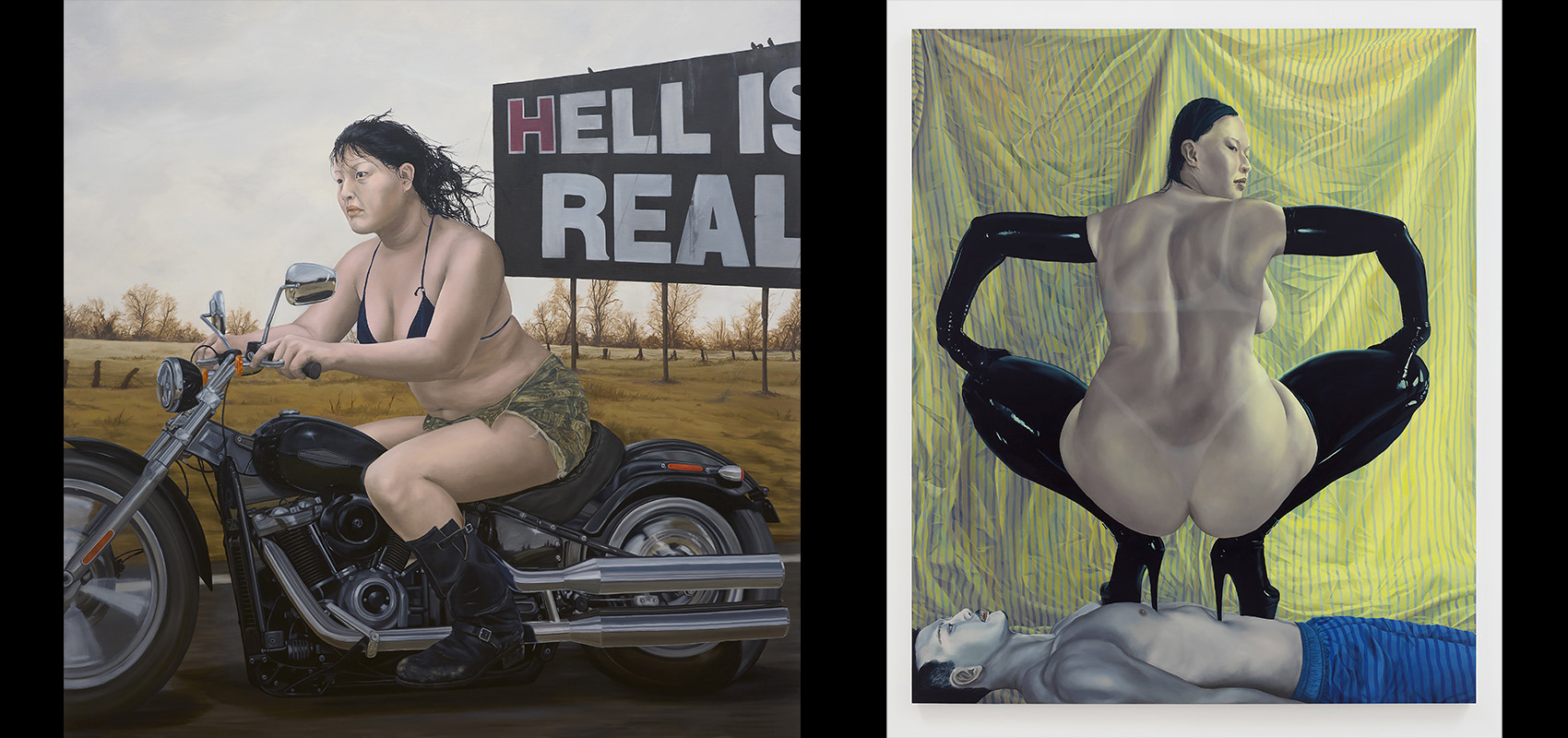
In Developing Desire last year, some of Ba’s figures were red, but many weren’t. All of them, however, were giants, their flesh towering over cities and inhabiting the Huangpu River in central Shanghai. She created the giantesses concept for her first solo show and it’s stuck. “I was interested in queerness and its relation to monstrosity,” she says. “Also, having these large female Asian figures as a way of pushing back on the feminization of the Orient at large, the sort of demureness, daintiness, and subservience.” The figures were also all naked. “What does RuPaul say? ‘We’re all born naked, and the rest is drag,’” she says. “I leave them nude if I want them to be an archetypal figure that’s not necessarily tethered to any particular place or time.”
Ba is continually learning and growing as her art develops. She looks at different painters for inspiration for every show. “I would say that I can actually list one to three [that are] important for each of my paintings,” she says. “I always look at Lisa Yuskavage—she’s a beast. And lately I’ve been looking a lot at Gerhard Richter and Ed Ruscha.”
Atmosphere and place are also important influences, and Ba traveled to China to do research for Developing Desire. She spent a summer mostly in Hefei—where she spent the first five years of her life with her grandparents—and visiting Shanghai, Hangzhou, and Chengdu. The show included the video More Future Triptych (2024), which pulls together raw footage that she filmed while observing life in Hefei.
“It always comes back to me somehow. Even through my research, sports are intricately connected with postcolonial studies, especially with China, the relationship between the East and the West.”
When I speak with Ba, she is in the “thick of it” for her upcoming exhibition at Micki Meng, San Francisco, called For Sport (opening May 22). Ba says she’s into sports just about as much as the average person. “I wouldn’t say I’m sports-obsessed, and I don’t follow a team or have any merch,” she says. “But I am interested in sports as a vehicle through which individual and national identity is formed.” Of course, choosing to focus on a topic where she’s something of an outsider is deliberate—Ba is actively seeking to turn away from herself, stretching, growing. She admits that she’s not always successful: “It always comes back to me somehow,” she says. “Even through my research, sports are intricately connected with postcolonial studies, especially with China, the relationship between the East and the West.”
Ba gladly and willingly goes “all guns blazing” on one theme for her shows, hyper-focusing until the last painting is done. “Then I usually go smooth brain afterward and try to think of something new,” she says. The brainwave for Ba’s upcoming show happened while she was watching the Paris Olympics. “Every time the Olympics come around, I think of the Beijing Olympics, which was like a huge zeitgeist moment,” she says. “It had me thinking, ‘Damn, why is France bringing in Lady Gaga and Celine Dion? Where is France’s own shit?’” This in turn made her think about soft power and how the Olympics go far beyond sports and reflect what’s happening globally.
“I think that’s something awesome about China,” she says. “The research is really interesting, but now I have to find a way to convey it in the work and not just make a bunch of pretty paintings.”
Like Ruscha, Ba tends to produce and organize her paintings in series. And when it comes to new projects, she likes to do extensive research. She recounts the introduction of Western sports in China through YMCAs in the post-Opium War era and gets excited when she talks about how China has always been really resistant to Christianity. “I think that’s something awesome about China,” she says. “The research is really interesting, but now I have to find a way to convey it in the work and not just make a bunch of pretty paintings.” It usually takes her up to a month to paint all of the works, and if she’s really pressed she insists she can pound them out in two weeks. “It’s quick, because I’m usually behind,” she adds.
As Ba’s work grows in new and unexpected directions, she moves from exploring herself and her own experiences to following where her curiosities take her. “When I was young and fresh, I made paintings about my own identity,” she says. “Now I’m not really interested in my personal experience or identity anymore—I feel I’ve exhausted it.”
At this point in her career, all inspiration points are inevitably leading back to China. “This is where I can’t get away from my own attachments,” she admits with a laugh. But her larger-than-life towering giantesses function as avatars in a way that’s far unlike herself (or any other person, for that matter). As Ba puts it: “I’ve never been a 10 ft story-tall giant.”

This feature first appeared in Mission’s Women of Today issue. Homepage banner: American Western, 2022, I-71, 2023, Resurrection Site, 2024. Homepage image American Western, 2022, inside image left, I-71, 2023 and inside image right, Spider, 2024 all courtesy of the artist Amanda Ba.