


Swapping OOTDs for media diets, this 19-year-old fashion intern is helping her online audience tap into the real world.
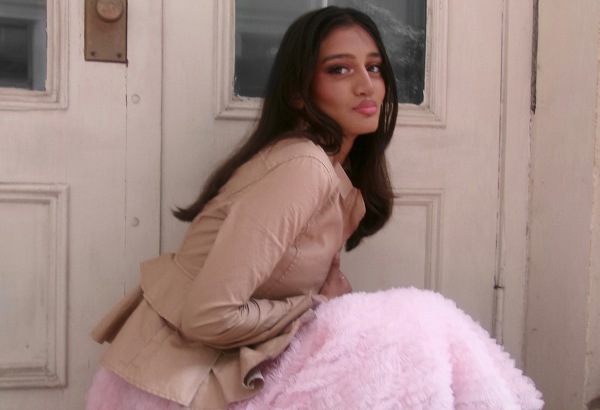
At just 19-years old, Ella Devi has faced both more scrutiny and acclaim online than the average person, all while dressed sharply in vintage Chanel. Through her youthful, impassioned vision, audiences are drawn into her online world of fashion commentary and analysis.
Devi has amassed over 300k combined followers across social platforms for her insights into the fashion industry and activism. Her success is just one example of youth-oriented tastemakers focused on informing audiences. “Kids may be scrambling to fill in the gaps in their knowledge, gaps caused by AI usage and failures of our education system. It’s important that people help them do that.”
The fashion scene tends to be saturated with a climate of constant consumption,yetDevi pushes back against this mentality. “Young people are realizing that they live in a country that prioritizes profit over people,” Devi says. “They are realizing exactly how systemic issues appear throughout their lives and are eager to understand how those issues tie into culture, including fashion.”
Her love for fashion was first fostered online. During quarantine, Devi found herself on “Fashion Twitter,” the side of the social media platform where industry professionals, casual enjoyers, and chronically online teenagers can freely discuss all things fashion. “Fashion Twitter was incredible back then because the industry people would be posting all day alongside the teenage fashion fangirls,” says Devi. “Information was so accessible.”
Accessibility is the key cog working the machine that is the online democratization of the fashion industry. In the past, conversations were kept behind paid print publications, exclusive shows, and years’ worth of fashion education. Now, every runway collection can be viewed, most garments in history can be researched, with more voices being heard.
To Devi, the digitization of the fashion world feels almost inevitable, but that’s not without its setbacks.. “Everyone is viewing high fashion through digital images now,” says Devi. “[It] makes the work so much more accessible, but … flattens the work from 3D into 2D and forces fashion people to think about how the work will be presented in the context of an algorithm.”
Authenticity, however, is what Devi finds essential to integrating offline and online worlds. “Audiences are gaining a sense of discernment when it comes to brands catering to the attention economy,” she says. “They know when brands are being intentional and when brands are just throwing stuff at the wall hoping it’ll stick to the algorithms.”
“Young women are left vulnerable to this on the internet not because they are influencers, but because they are young women in the (incredibly misogynistic and racist) public eye.”
Devi’s scathing criticism of the industry and astute understanding of the cultural climate is part of her content’s allure. Yet, the glamor of an online fashion presence can be deceiving. While Devi was adjusting to her first-year of college, she was “attacked en masse” for discovering that Pete Hegseth’s wife wore a dress from Temu to the 2026 White House Correspondents’ Dinner. The revelation initially sought to illustrate the irony of consuming Chinese manufactured products despite Hegseth’s America-first policy. However, her post was then spun by media outlets as an attempt to mock the couple unjustly, leading Devi to face waves of online harassment.
Influencer hate-trains springing up from online vitriol aren’t uncommon. What Devi faced, however, was a real fear for her own safety resulting from a seemingly benign realization she shared online. “My school offered me a bodyguard to walk me to and from classes, which I honestly should have taken them up on because that would have been so camp,” says Devi.
Beyond attacks on her character, she was primarily targeted for being a young woman of color. “I have seen real hate trains on the internet, ones that come about from angles of misogyny and racism,” says Devi. “Young women are left vulnerable to this on the internet not because they are influencers, but because they are young women in the (incredibly misogynistic and racist) public eye.”
In a world designed to make her feel small, Devi continues to stand up for good. Before curating her online presence, Devi canvassed for New York City mayoral candidate at the time, Zohran Mamdani, which brought her first wave of positive and negative traction online.
Amidst the scrutiny, she continues to take her messaging out to the real world, backing her opinions with actions. She recently traveled to Michigan to canvass for their primary elections. “You can talk about whatever big game you want online, but that doesn’t matter if you don’t make the effort to engage with your community to improve the material reality of people in this country,” Devi says.
Through her content, she is carving a unique identity for herself online. By combining both a passion for mobilization and high fashion, she is forming a community of informed and stylish viewers. “You can understand fashion with more depth if you study the historical and political context around the given time period.”
For fashion lovers, an expansive wardrobe should not merely be the goal. Rather, Devi calls for a deeper love of the art, one rooted in understanding the many systems fashion exists within. “When we use our clothing to make choices about our own fashion, we’re informed by the world around us.”