


Hoda Khamosh’s last name means “silent” in Persian, but silence has never been an option for this courageous Afghan poet, journalist, and activist.
Currently exiled in Norway, Khamosh dedicates every hour of every day to making the plight of Afghan women known to the world. “Millions of women are currently being subjected to gender apartheid by the Taliban,” she declared during a three-day meeting between Western diplomats and the Taliban in Oslo last year. “Women are systematically eliminated, denied, insulted, and humiliated. I feel their pain from thousands of miles away with my bones and hear their cries under the Taliban torture.”
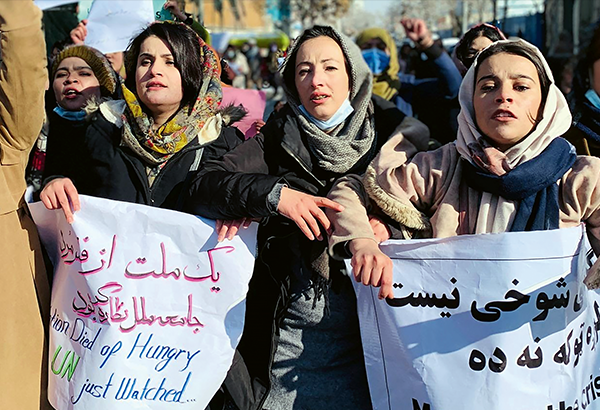
The meeting, which took place in January 2022, was an attempt to engage the Taliban leadership in negotiations with Afghan civil society members, including women activists and journalists. The Taliban’s reason for attending was to convince the West to unlock $9.5 billion that Afghanistan’s central bank holds in U.S. bonds, a mission that required postures of goodwill. By sitting at a table with Afghan feminists, along with flat out denying their brutal oppression of women’s rights, the Taliban ministers hoped they could convincingly soften their fundamentalist image. This dashed Khamosh’s hopes of any potential for progress. “When I realized that the Taliban were seeking recognition from the world with obvious lies, I protested their crimes,” says Khamosh, who defiantly held up photos of missing women protesters and activists being tortured in Taliban prisons, thus exposing the regime’s hypocrisy to the cameras.
Though the meeting ended without any diplomatic breakthroughs, Khamosh had no choice but to stay behind; her high-profile protest made life in Afghanistan too dangerous. “After the meeting I received threats against me and my family,” she says, “If I want to go back to Afghanistan, I have to accept my death, because the Taliban do not want to have an opponent in front of them.”
Khamosh continues to fight, remotely and tirelessly, from a country that is culturally and geographically opposite from her own. She is in constant contact with her peers in Afghanistan, organizing protests and clandestine meetings, reporting on atrocities on social media, and offering advice and practical support. “My connection with Afghanistan gets stronger and stronger every day,” she says “People send me messages from all over the country. They ask for help and I can help them in some cases, but not all of them. It makes me proud of myself and proud of them, and every time that I can make a difference, it makes me feel more human.”
Fighting for others also helps her combat the isolation and heartache of being separated from her loved ones. “Being away from my family sometimes makes me fall hard to the ground,” she admits. “I get lonely and tired, I cry for hours, but I get up again. When I sink into sadness, I hear many voices behind me that need help. These pains and these sad voices make me strong so that I can bring their message to the world.”
“I grew up in a traditional and strict family that did not allow their daughters to study. When we came back from Iran, we faced many problems. My mother was an educated woman, she tried to study and work, but my father’s family prevented me from going to school.”
Finding strength through despair is not new for Khamosh, whose life has been defined by her refusal to surrender to patriarchal oppression. She was born in Iran, where her parents had moved from Afghanistan, and had finished high school when her family returned to their home province of Pawan in the north of Kabul. The move back was difficult, as her family was reunited with Khamosh’s father’s extended family, who were not on board with the emancipation of their female ex-pat relatives.
“I grew up in a traditional and strict family that did not allow their daughters to study,” she says. “When we came back from Iran, we faced many problems. My mother was an educated woman, she tried to study and work, but my father’s family prevented me from going to school.” Khamosh’s mother defied her husband’s family by working as an educator and championing women’s rights. Her resistance was brought to the attention of the Taliban, who punished her with murder.
“One dark morning at sunrise I saw her hanging from the ceiling of the house; they had killed her and hanged her with a scarf,” Khamosh recounts. She was 18 at the time, and the loss fueled her determination to fight back. “My mother’s death made me stronger in the face of difficulties,” she explains. “No worries can stop my work and activities.”
She managed to beg and cajole her way to the university entrance exam and was accepted. From there, her life in the arts, activism, and media started to blossom. She started writing poetry and secretly worked as a reporter for local publications and radio stations. But her independence was still a threat to her relatives. “They tried to disown me many times by humiliating my family and beating me,” she says. The attempts to cow her into submission failed miserably as Khamosh’s confidence and resourcefulness only continued to thrive.
She subverted the notion of traditional marriage by proposing to her husband, a graphic designer with whom she ran a publishing house before the Taliban takeover, and celebrated every aspect of womanhood in her work, from teaching pubescent schoolgirls about menstrual health to writing erotic poetry. She also supported female empowerment on an economic level by organizing tailoring workshops for female entrepreneurs and creating a national and international sales network for their goods, as well as conducting training courses for women in villages and helping them build small banks.
But the Taliban takeover sought to grind all this progress to a terrible halt. Life in Afghanistan became insupportable for educated women, who were not only stripped of their rights but also their livelihoods. “The conditions in Afghanistan are very severe,” says Khamosh. “It’s not just about education and the right to work. It’s literally about finding ways to eat and keep clothes on your body.” To help, she has set up the Afghanistan Women’s Justice Movement, a foundation that secretly provides women with education, healthcare, economic opportunities, and a path to resistance. “We strengthen them against violence, restrictions, and terrible killings, because they need a strong spirit to survive,” she says. “We invite women to study and stand up against violence because society has been taken from us and we have to provide ourselves with the resources to be sustainable.”
Courage and technology help them sustain this lifesaving work under the Taliban’s terror. “We are in contact through online calls and groups, and through this we hold Zoom meetings and plan and organize,” says Khamosh. “This is the only form of communication that we can use for our programs, but we often don’t have enough internet and money.” A lifelong experience of self-empowerment under secrecy and hiding have helped the women organize underground and outsmart the Taliban.
Using the cover of religious study groups, girls between the ages of 10 and 18 gather in hidden night schools where they receive education in health, language, and the arts. And what if they get caught? “When the Taliban comes to our gatherings and knock on the doors, we tell them that we have permission to study the Quran and that they cannot enter because there are only women in here,” says Khamosh.
“The Taliban are actually nothing but a bunch of uneducated men. Their greatest fear is smart and powerful women, because they know they are weak. So if we can unite and educate everybody, we can take them down. We’re not going away. Ever.”
Looking at the catastrophic situation in Afghanistan from the comfortable distance of a Western society, it’s easy to feel overwhelmed and helpless. How can this society, which, even aside from the Taliban’s terror, is mired in corruption, ethnic oppression, and poverty, find a way to justice and freedom? Afghan women like Khamosh, however, can’t afford to feel overwhelmed.
She has to use whatever means possible to make the regime’s crimes visible to the world. But bringing attention to these atrocities is only useful if the world takes action. “The only thing that can make a difference is lack of support,” says Khamosh. “The international community has to stop trying to engage with [the Taliban] and cut them off from all funding. These 18 months have shown that we cannot change anything through dialogue. The only way to bring change is to overthrow them.”
And how can that happen? The greatest threat to the oppressors is the oppressed, according to Khamosh, who says that the path forward lies in the solidarity of women. “We ask the global feminist community to continue to stand by us and to make our voice heard in the world. It’s the women who give me power and hope to continue because we will have means of power. The Taliban are actually nothing but a bunch of uneducated men. Their greatest fear is smart and powerful women, because they know they are weak. So if we can unite and educate everybody, we can take them down. We’re not going away. Ever.”
From Mission’s Bipoc Issue. All images courtesy of Hoda Khamosh.