



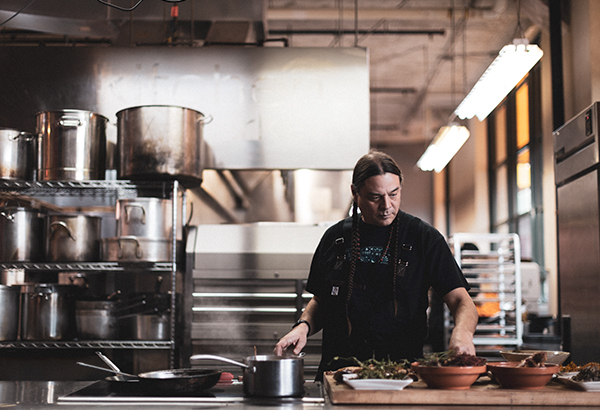
“We turned out 10,000 meals a week out of our kitchen. We completely pivoted to food support and relief.”
Sean Sherman is a man not easily categorized. The mischievous Native American boy who often did not have enough to eat growing up is today’s award-winning chef, entrepreneur, author, and activist. He is a force in strengthening Native American culture and wellbeing, promoting diversity, and taking a stand on issues of the day. Not one to be pegged, he calls himself “a door-kicker-opener.”
Sherman’s food persona, the Sioux Chef, has more than 125,000 followers on Instagram, where he highlights Native American foods, supports the reclaiming of Native American culture, is a thought leader on Indigenous food systems and policy, and promotes social activism.
The chef’s Native American roots run deep. Born on the Pine Ridge Reservation in South Dakota, he is an enrolled member of the Oglala Lakota. Sherman’s grandparents were in the first generation to go through forced boarding schools, haircutting, and learning Christianity and English. Sherman’s father launched a nonprofit known as the Lakota Fund in the 1980s to provide small business loans for struggling Native Americans. His mother, currently a Lutheran reverend, worked in South Dakota politics when Sherman was young. Following his parents’ divorce, Sherman’s mother moved him and his sister off the reservation and juggled multiple jobs to keep food on the table.
Sherman, started college in South Dakota but realized he wanted to pursue an education in art. Though he didn’t know much about Minneapolis other than the music of Prince and The Replacements, he moved there because “I just thought it was a cool city.” Though his plan to attend the Minneapolis College of Art and Design fell apart because he couldn’t afford the tuition, Sherman describes the city as “a great home base, really the start of everything for me.” A lifetime of achievement later, the college invited Sherman to be the commencement speaker and bestowed an honorary doctorate upon him in 2023.
A self-educated chef, Sherman focuses on the “interconnectedness of plants, animals, and humans in Native food systems.” He believes in the storytelling power of food, “how each bit carries centuries of history and cultural significance.” Reclaiming Native American traditions is more than just cooking—it is a quest for identity.
The road to recognition and stability has been a tortured one for Native Americans. Land was seized, youngsters were sent to boarding schools where their cultural ways were Americanized, citizenship and the right to vote were denied, and their food ecosystem was overtaken. Native plants and animals were colonized and replaced with less healthy, less accessible alternatives.
While Native Americans practiced self-government here long before the establishment of the federal government, they struggled for centuries to enjoy full U.S. citizenship and voting rights. In 1924, President Calvin Coolidge signed the Snyder Act—also known as the Indian Citizenship Act—conferring full citizenship on Native Americans who were born here. The act also established the right to vote, but many states did not comply. It was not until the Voting Rights Act was passed in 1965 that all Native Americans had a voice at the ballot box.
According to U.S. census data, the number of people in the country who identify as at least partially Native American almost doubled between 2010 and 2020. The population, currently over 7 million, is projected to grow to roughly 9 million over the next 25 years. A variety of sociological, cultural, health, and census-taking procedures are cited for the jump. But despite the growing numbers, many old prejudices persist. “We haven’t had a chance to heal, much less move forward,” Sherman notes.
“By investing into their own food systems, they can secure cultural resilience and paint a better future of what’s possible, especially with nutritional access, and combating a lot of the food-borne illnesses that have been really prevalent, especially in places like where I grew up.”
In recognition of the tortured history of Native Americans,Sherman calls the story of Thanksgiving “a harmful lie” in a 2018 Time.com piece. He argues that we should embrace the fact that most Thanksgiving recipes are made with Indigenous foods and “focus on values that apply to everybody: togetherness, generosity, and gratitude.” And in so doing, “we can make the day about what everybody wants to talk and think about anyway: the food.”
Indigenous food sovereignty is the seed from which Sherman’s work has grown. He seeks to teach Native peoples that “by investing into their own food systems, they can secure cultural resilience and paint a better future of what’s possible, especially with nutritional access, and combating a lot of the food-borne illnesses that have been really prevalent, especially in places like where I grew up.” He looks to give the “power of understanding the power of food back to tribes.”
Also in 2018, Sherman founded the North American Traditional Indigenous Food Systems (NATIFS) nonprofit to enhance food education and access, generate wealth, and provide healthy foods for Native communities. Based in Minneapolis, NATIFS supports entrepreneurs, offers classes, and provides access to ingredients from Indigenous purveyors. True to Sherman’s vision, NATIFS works to cultivate the seeds of Native American heritage to “restore knowledge lost due to forced assimilation.”
Sherman’s award-winning restaurant Owamni, also based in Minneapolis, uses only decolonized ingredients—those items that were “here first” in America, such as bison, potatoes, and corn, and not those that were brought here, like wheat, sugar, dairy, and livestock. The benefits of an Indigenous diet, according to Sherman, include low salt, healthy fats, diverse proteins and plants, and organic agriculture. He believes in the beauty of local harvesting and says, “Lawns are fucking stupid, we should just grow food.”
Owamni’s menu includes hand-harvested wild rice, crickets and popcorn, game tartare, bison bone marrow, and quail thighs. While there is no dairy, wheat flour, cane sugar, beef, pork, or chicken, Sherman notes, “There’s some pieces that do slip in, like coffee. It’s kind of a necessity in a restaurant.” Sugar is replaced with maple, honey, agave, and fruit; beer is bought from BIPOC producers and wine from Mexican and Black-owned wineries. “We try to be intentional with our messaging no matter what we’re doing,” Sherman says. Owamni was named a 2024 Restaurant of the Year by USA Today.
Sherman is not an isolated Midwestern chef with a clever marketing plan. He has authored two cookbooks, is a three-time James Beard Foundation award winner, the first Native American to receive the Julia Child Award, and a Time magazine 100 Most Influential People awardee. Time noted: “Sean has galvanized a new generation of Indigenous chefs to honor their culinary heritage and to decolonize their diets.”
In his TED talk “How to Eat with Awareness and Purpose | How to Be a Better Human,” Sherman argues that the Western diet has “ignored what’s right here. It is industrialized.” In describing his focus on food as an ecosystem of history, culture, people, and place, Sherman said, “Food tells a story on a plate.”
“I’ve learnt over time to utilize my voice as my platform has grown.”
A perhaps unexpected aspect of Sherman’s journey is Minneapolis itself. The scene of the George Floyd, Renée Good, and Alex Pretti murders, the city has been a difficult place to build and sustain a business. After Floyd was killed in the spring of 2020, the area near Owamni was a “war-torn mess with buildings on fire everywhere,” Sherman says. Just as he and others worked to move food out to struggling people, COVID-19 made its debut. During the winter of that year, “we turned out 10,000 meals a week out of our kitchen.” With the restaurant closed to patrons, “we completely pivoted to food support and relief.” Ironically, Sherman’s own battle with COVID saddled him with a loss of taste until the virus passed: “Everything just tasted like a salty sock.”
More recently, with Minneapolis being the epicenter of the U.S. government’s anti-immigrant enforcement measures, Sherman is taking a stand. Raised on politics and unafraid to challenge authority, he says, “I’ve learnt over time to utilize my voice as my platform has grown.” He deeply understands the relationship between people and place.
Sherman views the Trump administration in general, and the ICE raids in particular, as the antithesis of everything his work stands for: “‘Indigenous’ is one of the key words they’ve banned.” And for Sherman and his Owamni staff, this is deeply personal. Living there involves using both AI and personal networks to surveil hotspots of ICE activity and turning off cell-phone signals to avoid detection. Sherman fears the local horror could crash the whole food-system economy—“every part of the chain, from farm workers to producers and processors to distributors, restaurants, caterers, institutions, kitchens, universities, hospitals, and tourism.”
Sherman personally took his message to Washington, D.C., along with a letter bearing more than 1,500 signatures demanding, among other things, the withdrawal of ICE from Minneapolis and an investigation into the deaths there involving federal agents. “No industry built on labor can function under terror,” he wrote.
Today, Sherman says there are far fewer ICE agents in Minneapolis than there were and “it doesn’t feel as unsafe as it did.” And while people have not yet let their guard down there, the relocation and expansion of Owamni continues. Between the growing waitlist for reservations and the lease being up, it was time to think ahead. This past June, Sherman will open Indigena a couple of blocks away, with three times as many seats and an expanded menu. “I believe in humanity. I believe that we’ll get through this somehow.”
He has certainly fought and won many an uphill battle before.
Homepage image by David Alvarado, inside image courtesy of Sean Sherman. This feature originally appeared in Mission’s Biodiversity issue.