


Through his studio Tin Drum, Eckert is creating shared, screenless experiences that challenge the disposable nature of modern media and bring physical rituals back to digital art.
Todd Eckert sits in the front room of his New York City apartment, a space that has visibly surrendered to his love of music. Behind him, floor to ceiling shelves are absolutely packed with hundreds, maybe thousands of neatly stacked CDs and vinyl records. In the middle of it all sits a record player as the centre piece of this impressive archive. He’s just come back inside from a run, and if the wall behind him wasn’t enough evidence of his passion for music, he’s also just been delivered a small parcel. “This is a numbered single from a band, they’re called 1000 Rabbits,” he explains as he opens the package. “I randomly heard this the other day. I love shit like this. It’s the only single that this band has.” He pulls out a CD from the package and holds it up. “It’s called Virgin Soil. They’re British.”
“The truth is that whatever it is that they’re watching, they will not remember it. It’s this idea of disposable media, and because of the simplicity with which we can engage with that content, it no longer has value.”
Despite the vast collection Eckert currently possesses, he admits that he actually stopped buying records at some point because the thousands that he had originally collected from a young age were stolen all at once. Despite that loss, he says he still has clear memories of those records. “We have this, I think, mistaken belief that ease of consumption is a good thing,” he says. He makes an example of those who watch things on their phones while on public transport. “The truth is that whatever it is that they’re watching, they will not remember it. It’s this idea of disposable media, and because of the simplicity with which we can engage with that content, it no longer has value.”
For the founder of Tin Drum, a pioneering mixed-reality studio, Eckert’s passion for the physical, real world might seem like a contradiction. But after an hour of conversation, it becomes clear. His journey into the future, and his use of cutting-edge technology, is entirely fuelled by a relentless pursuit of human authenticity. In fact, Eckert’s love for physical, tangible media started from childhood.
Growing up in a working-class family that eventually settled in Texas, he didn’t just want a Peter Gabriel record from the store; he wanted the original, authentic British pressing. And when he discovered the Japanese versions had extra tracks and distinct artwork, he saved his money up and waited months for those, too. It was that fierce dedication to the details, the difference between a matte and shiny record sleeve, that catapulted him into music journalism. By age 14, he was getting published; by 17, he was editing a national music magazine. Upon graduating college however, he reluctantly moved to Los Angeles the very same night after losing a bet to a friend.
That detour eventually led him to produce Control, the acclaimed 2007 biopic about Joy Division’s Ian Curtis. True to form, Eckert refused to fictionalize the story for an easy American sell, insisting on absolute authenticity—even filming in Curtis’s actual home and using verbatim copies of his private letters. His transition into technology then began with video games, acting as a bridge between the programmers writing the code and the audience experiencing the “wrapper” of the game. But the true epiphany came when a friend connected him with a fledgling start-up operating out of a cramped office in Florida: Magic Leap. “You’re looking through these little holes and there is no screen… what you saw was information embedded in light, poured into the light that was everywhere else,” Eckert explains. “I always thought that screens had to be everywhere because it never occurred to me how sight works. It was an epiphany.”
He subsequently became one of Magic Leap’s earliest employees, spending four years defining what mixed reality could be. But as the company eventually raised hundreds of millions of dollars in funding, the culture shifted. Eckert says the focus drifted from human-centric art to what he views as the corrosive forces of modern tech. So, he walked away, leaving to start his own company.
“Our songs, our performances, our stories have never been more meaningful than in a time like now, when identity is so vague.”
Eckert doesn’t mince words when it comes to the state of the tech industry. He views modern data-harvesting practices and the push toward isolation as an active threat to our humanity, spearheaded by what he calls “hypertransactional fuckheads.”
“Our songs, our performances, our stories have never been more meaningful than in a time like now, when identity is so vague,” he explains. “They are very good at imposing a sense of isolation, and that isolation means they usually win. That’s why we’re not talking on the subway. We’re sitting around looking at our stupid phones.” This philosophy naturally extends to his views on Artificial Intelligence in creative spaces. While many talk about AI as being an inevitable force we must accept in our lives, Eckert sees it as the ultimate devaluation of the human mind. “People leaving the writing to a robot simply means that your mind will lose the mechanism by which it is able to elucidate how it feels,” he argues. “AI so far is the solution to problems that people don’t have.”
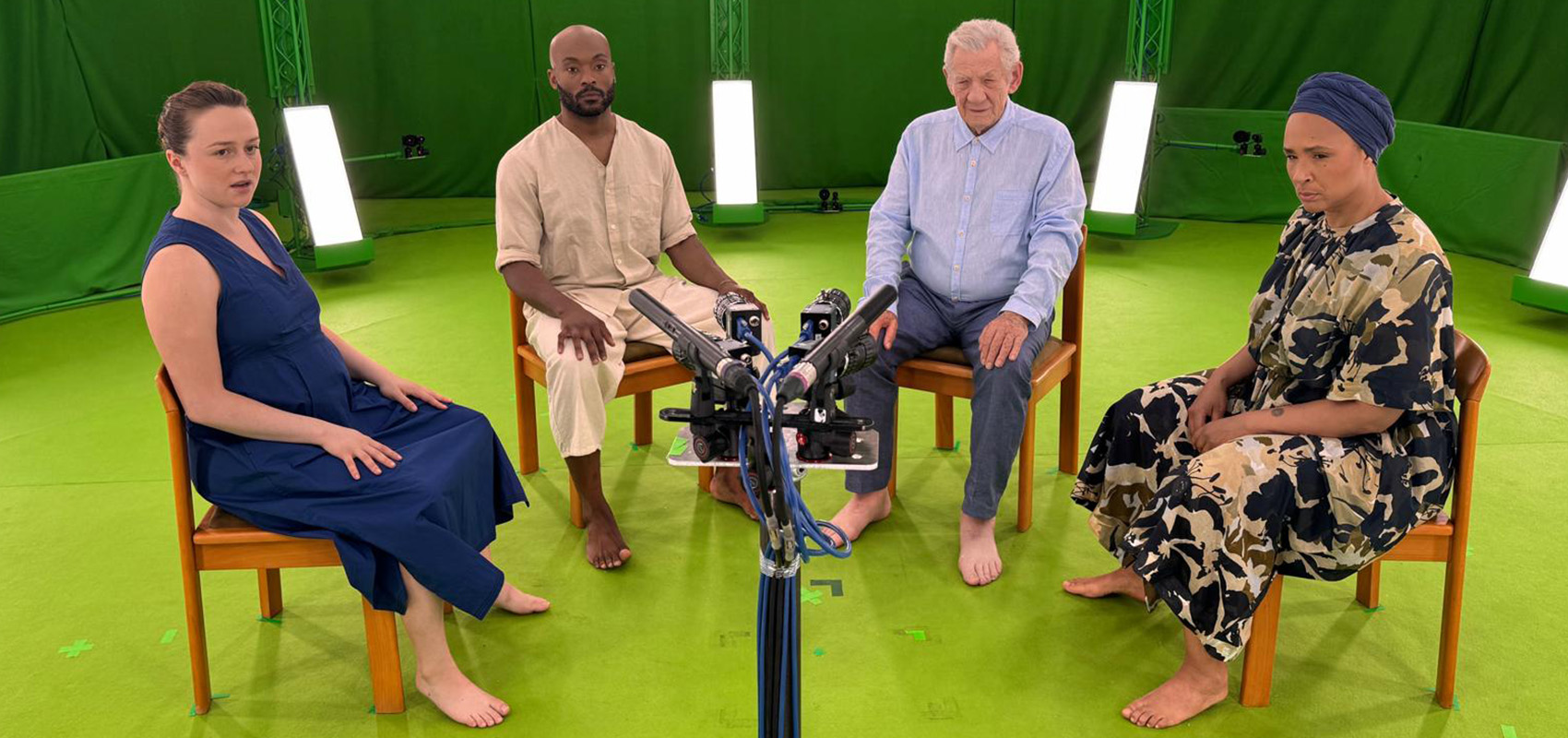
With Tin Drum, Eckert is creating the antidote to digital isolation. His mixed-reality shows are designed to be communal, un-recordable, and deeply human. Tin Drum operates on strict principles: they do not harvest user data, and the experiences are designed solely to be lived in the moment. Currently showing at NYC’s The Shed, their latest piece An Ark (written by Simon Stephens), invites 180 people at a time into a sacred, curtained space. The audience is asked to remove their shoes, a subtle nod to stripping away possessions to experience something elemental. They’re then given translucent glasses that overlay digital elements while still allowing them to see the actors and their fellow audience members.
“If you see Kagami, it feels like you’re seeing Ryuichi actually in the room. The idea that after he died, more than 100,000 people could feel like they saw him… even if I never make anything else, I will feel successful just because we did that.”
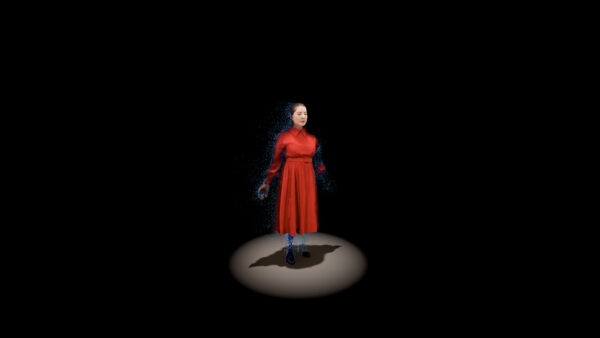
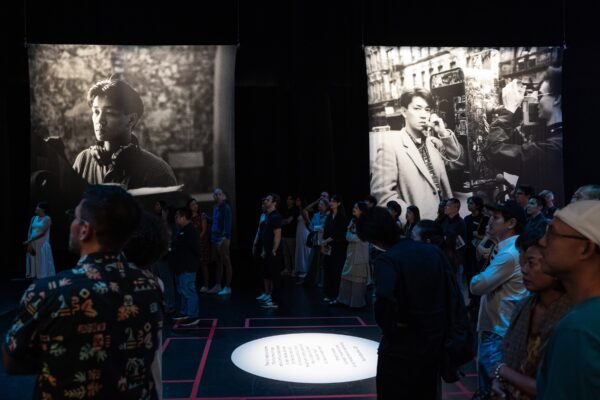
But perhaps Tin Drum’s most poignant achievement is Kagami, a mixed-reality concert featuring the late legendary composer Ryuichi Sakamoto. Conceived in 2020 before Sakamoto’s passing, the piece allows audiences to feel as though they are sitting in the room with the maestro as he plays. “If you watch a traditional film, that is an artifact of something that you weren’t there to see,” Eckert says. “If you see Kagami, it feels like you’re seeing Ryuichi actually in the room. The idea that after he died, more than 100,000 people could feel like they saw him… even if I never make anything else, I will feel successful just because we did that.”
Next, Kagami will be soon heading to Osaka, Japan, in an extended form, complete with an exclusive, previously unreleased record of Sakamoto’s music. It’s a fitting full-circle moment for Eckert: utilizing advanced technology to bring people together, while still honoring the importance of authenticity and the value of a creative work.
Home page banner video An Ark by Rachel Louise Brown. Home page image Todd Eckert by by Luigi and Iango. Inside image All images courtesy of Todd Eckert/Bread and Butter Pr. An Ark is on at The Shed in NYC till April 4th.