



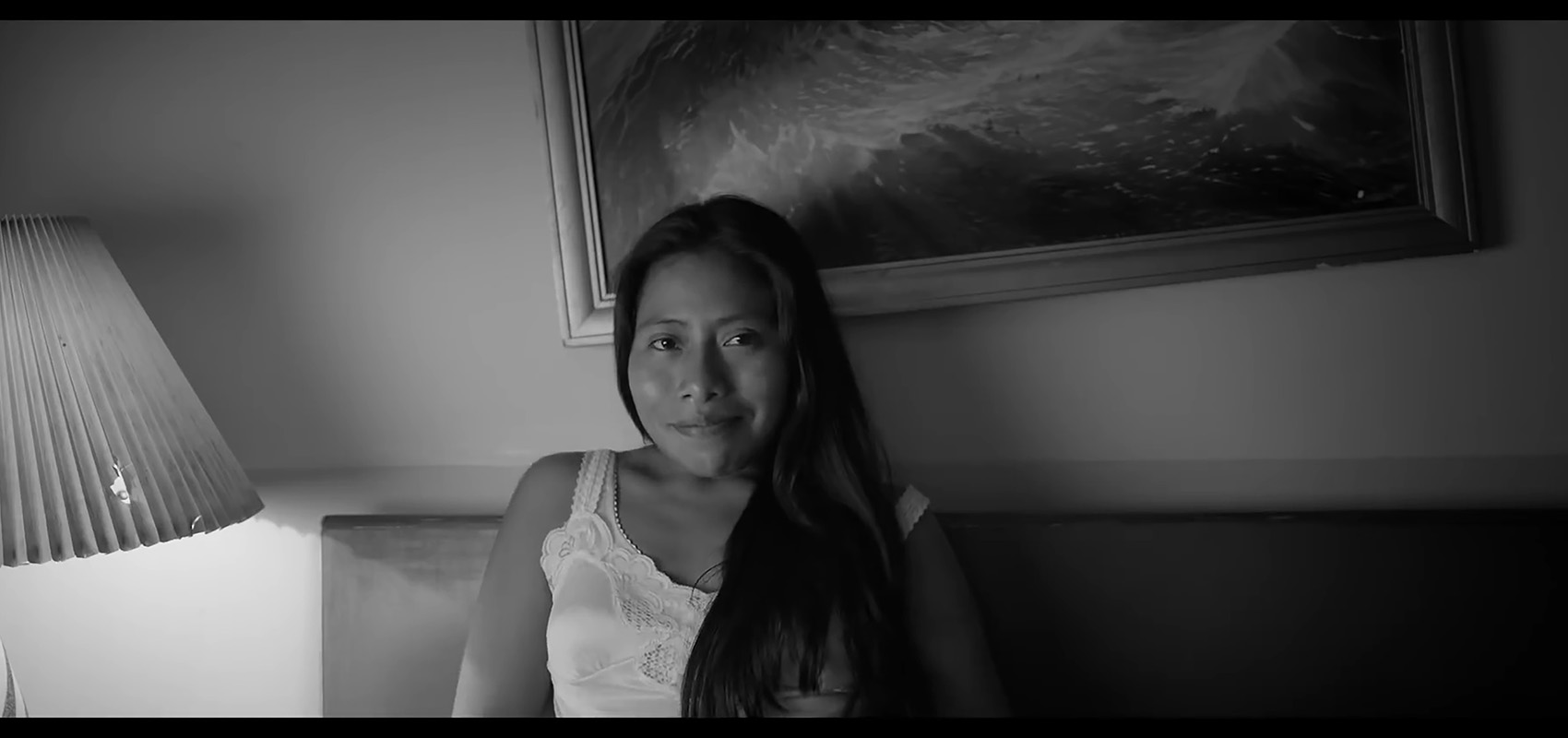
Yalitza Aparicio never aspired to be a film star, much less win an Oscar. But her debut role in Roma not only launched an acting career, it also helped advocate for others.
In 2018, Yalitza Aparicio soared to the top of the cinema stratosphere, prompting the question of whether Indigenous actors can have a place in Hollywood, one where their talent and identity can coexist with the established criteria of what stars can look like and stand for. The then 25-year-old Mexican actress challenged those preconceived notions when she made her acting debut in Alfonso Cuarón’s Netflix drama, Roma. Her moving performance as Cleo, a live-in maid who finds herself struggling with an unexpected pregnancy and her employers’ tumultuous marriage, landed the breakout star an Oscar nomination, making Aparicio the first Indigenous woman ever nominated for Best Actress. (The film also won Oscars for Best Foreign Language Film, Best Cinematography, and Best Director.) Her debut not only offered the world a look at a new era of cinema stars but also made strides toward bringing Indigenous representation and talent to the forefront.
Before amassing global fame and prestigious titles such as one of Time magazine’s 100 most influential people in the world, Aparicio had a solid foundation. “I have always believed that the people we are today is the result of everything we have done throughout our lives,” she says. “Personally, I am proud to have had an upbringing full of values. In my house, they taught us that we all deserved the same opportunities, and that we should support each other, and that although the road would be complicated, the most important thing was to be clear about where we came from and what we wanted.”
“I have always believed that the people we are today is the result of everything we have done throughout our lives.”
Born in Oaxaca, Mexico, to parents of Mixtec and Triqui origins, Aparicio says her childhood was filled with Indigenous influences. “Around the age of 7, I began to have the influence of Indigenous women, who inspired me [because I saw they were] proud of their origins and sharing their wisdom.” In the face of ever-present societal discrimination, her family instilled a strong sense of cultural pride and emphasized education and learning as a means of growth. “Despite the financial shortages that arose in my home, we were all in constant struggle to move forward with our dreams, and we did this by financially supporting school expenses.”
Aparicio was pursuing a university degree with the goal of becoming an elementary school teacher when an audition for Roma was held in her hometown of Tlaxiaco. Aparicio was initially uninterested in participating, but her sister, Edith, who could not audition herself because she was pregnant, pushed her to take a chance. That spontaneous decision would forever change the course of her life. “During my childhood, I had never dreamed of being on a screen due to the lack of representation and not identifying with what I saw, and consequently, assimilating that it was not a place where I could belong,” she explains.
After impressing Cuarón and the producers in three successful auditions, Aparicio landed the lead role of Cleo and embarked on what would be a pivotal journey not only for herself but for the Indigenous community around the world, bringing a sense of hope for underrepresented people like her. “When something motivates you, you find the strength to hold on to your dreams,” she says. Still, it was no easy undertaking. Upon accepting the role, Aparicio discovered that she would need to learn how to speak Mixtec, a language native to the Mixtecs of Mexico, where a variety of the language is spoken by about half a million people. With this in mind, she embraced the challenges of learning the language, making her performance all the more impressive. “At first, I did not measure how far the film would go or how many people would see it, but the fact that the big screen would reflect an Indigenous language meant visibility for Native people, as well as sharing the cultural richness that we have.”
“I believe it is possible for diversity to work with activism in this industry, [as it can] bring to light issues that affect us as a society.”
It wasn’t until after the film was released and received an overwhelming response that Aparicio realized how much her presence onscreen mattered, even in the evolving landscape of film. “I believe it is possible for diversity to work with activism in this industry, [as it can] bring to light issues that affect us as a society,” she says. “Since cinema reaches many parts of the world, it connects us despite having grown up in different places with other cultures and customs.” Even in her home country, the need for visibility is dire to ensure that the culture of Indigenous folks doesn’t disappear. “[It’s] difficult to understand why we have a degree of racism in society, and how it’s possible that in my own country there is not a vast knowledge regarding Native communities and Indigenous languages, in addition to diversity in appearance.”
Aparicio worries about the effects that a lack of education of one’s culture can have on the communities that desperately need to keep their history alive. “It worries me to think about the lacking educational system that we manage and [how it] led society to ignore the culture of our country,” she says. “One of the many consequences that exist when discriminating against Indigenous peoples is losing Indigenous languages with a world of ancestral knowledge.”
In 2019, Aparicio was named a UNESCO Goodwill Ambassador for Indigenous Peoples, and she continues to champion her community and the many talented people just like her. “When they proposed the possibility of being an ambassador, I had doubts. I was not sure if I could do it or if I would do it in the right way,” she says. “Due to discrimination toward Native people, I had lost the right to speak my two Indigenous languages, Mixtec and Triqui, and that was precisely what triggered my decision to accept the [ambassadorship]. This situation should no longer continue, and no one should be forced to hide their knowledge and origin to avoid being discriminated against. Society must know all the cultural wealth that we have, and this was the way to reach them.”
Now, as she gears up for more opportunities and acting roles that will further propel Indigenous inclusion and visibility in every aspect of society, Aparicio is confident that her representation will help the voiceless in demanding recognition: “Having the opportunity to give a voice to people similar to me made me realize that what I wanted was for the new generations not to go through what I experienced—being surrounded by discrimination and only aspiring to tasks limited by their appearance—[and that] being Indigenous does not limit you to one series of possibilities in life.”
Roma, official trailer courtesy of Netflix. This feature first appeared in Mission’s Bipoc issue. Get the digital issue here.