


The Swiss explorer, environmental advocate, and champion of clean technologies Bertrand Piccard will never stop pushing boundaries to discover new ways to preserve the health of the planet and all its inhabitants.
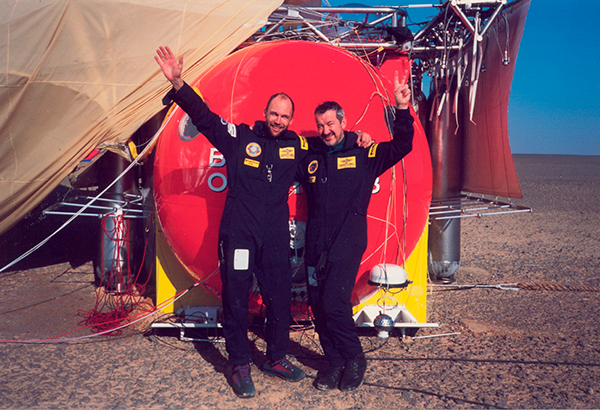
“We decided we would be the first to fly around the world nonstop in a balloon,” says the French-accented aeronaut. The mission: a 28,000-mile, 9,000-foot-high, 20-day odyssey. Cataclysmic thunderstorms above and hostile countries below were only two of their challenges. “So what do you do? You make [an emergency] landing? And for the rest of your life you ask yourself every morning, was it a good decision? Or you go for it. And you see what happens.”
So says Dr. Bertrand Piccard in The Balloonists, a new documentary about the 1999 attempt he and the English aviator Brian Jones made to circumnavigate the globe in Breitling Orbiter 3. Spoiler alert: He and his crew mate went for it. No-spoiler alert: They survived the journey, Piccard living to fight another day and push another message about the beauty of planet Earth and the urgency of saving it.
Piccard is, in all the best and most appropriate ways, a highflier. He’s a member of The Explorers Club, the New York-based research, exploration, and conservation society. That’s where he first encountered his good friend David de Rothschild, the British environmentalist, entrepreneur, and adventurer, who is also featured in these pages. “We meet there on a regular basis. Also, we are both ambassadors for Breitling—we are in the Explorer Squad, promoting exploration.”
In May 2025, at a ceremony at the Élysée Palace, Paris, the Swiss explorer, psychiatrist, and environmentalist Piccard, now 68, was duly promoted to Commander of the Legion of Honor by French President Emmanuel Macron. It was Piccard’s latest elevation: He had been awarded the rank of Chevalier in the wake of that 1999 circumnavigation. He was then made Officier after his and his co-pilot André Borschberg’s history-making flight round the world in a solar-powered airplane, Solar Impulse, completed in 2016.
The latest accolade is in recognition of the work of Piccard’s Solar Impulse Foundation in finding more than 1,600 technological solutions to help industry save both its profit margins and the planet. Protecting biodiversity, Piccard says, enables businesses to reduce their energy use and CO2 emissions.
“We have to understand that there are two levels,” the Lausanne-based innovator begins. “One level is to decrease the quantity of energy we use, and at the same time, to do better. This is efficiency, when you do better by consuming less. You have less cost, less waste, less pollution, less damage on the environment, but also more profit, because your energy bill will be lower.”
Today, he says, the world is doing the opposite. We are, as he puts it, “wasting energy like hell”—where “like hell” means 70% of energy produced—“just because of the inefficiency of the systems we use. Thermal engines need three times more energy than an electric engine. Houses are badly insulated. If we were using heat pumps instead of gas or oil to heat a house, we would save 80% of energy. There are old industrial processes where energy is wasted.”
Then there is most nation states’ ruinous carbon habit, the annual multibillion-dollar production and/or importation of oil, gas, and coal. Every year that energy, that cost, literally goes up in smoke. “If you put billions into renewable energies—power plants, solar, wind, geothermal, hydro-electricity—what do you have at the end of the year?” Piccard asks. “You have a facility that will produce energy for 30 [more] years.” That energy sovereignty, he adds, is the language spoken by corporations and governments. “We have to see that, okay, speaking of climate is very important. Speaking of biodiversity is crucial. But if you want to speak to governments or big corporations, you have to tell them that renewable energy and energy efficiency are a source of competitiveness, cheaper energy, more profit, more independence, and more sovereignty.”
“If you put billions into renewable energies—power plants, solar, wind, geothermal, hydro-electricity—what do you have at the end of the year?You have a facility that will produce energy for 30 [more] years.”
Bertrand Piccard
It is a catastrophic irony that Piccard and I are speaking within the first month of the war in the Middle East. America and Israel’s onslaught on Iran has resulted in Iran imperiling shipping in the Strait of Hormuz, choking global oil supplies. The result: rocketing energy bills around the world. Piccard nods grimly at this. “Renewable energies were criticized, people saying they were intermittent, unreliable, too expensive. But now we see that oil and gas are much more intermittent, unreliable, expensive. If we want to have a good future, we have to get rid of this dependency, not only for the climate but also for the economy.”
Piccard’s skyscraping ambition doesn’t stop there. He’s deep into the development of Climate Impulse, a hydrogen-powered aircraft that, in the next two years, he and Raphaël Dinelli will pilot round the world on a nonstop, zero-emission flight. How hopeful is he that the wider aviation industry will eventually embrace hydrogen-powered aircraft?
“With no memory of what happened in the past, you can be very pessimistic about hydrogen airplanes,” he says. “You think, ‘It’s too complicated, too expensive, it will never work.’ But if you have a good memory of the past, you will see that, several times, we had major changes like this. When we switched from the horse to the car and the truck, many people said, ‘Oh, you cannot change everything. It doesn’t work. It’s much easier to give grass to the horse than to make gas stations everywhere.’ Today you have gas stations everywhere.”
Piccard continues, “When the first mobile phone was on the market, it cost $15,000 and was as big as a suitcase. Today we all have one in the pocket for a couple of hundred bucks.” Photovoltaic technology, which converts sunlight to electricity, is “the same. Photovoltaic, 30 years ago, was 40 times more expensive than it is today.
“When you look at that, it might be exactly the same for hydrogen. The price will go down. There will be hydrogen power plants. There will be distribution of hydrogen at airports. Of course it will change a lot of things, but that’s called evolution, and I believe it will happen.”
With no memory of what happened in the past, you can be very pessimistic about hydrogen airplanes.”
But the accolades matter less for Piccard than the attention they bring, the awareness, the media coverage. He has long understood that the higher, farther, deeper you go, the greater the thrills but also the more impactful the message. That awareness, he explains, goes right back to the childhood of this European, who hails from a long line of explorers. “When I was 11 years old, I was living in Florida, close to Cape Kennedy and Cape Canaveral. That was during the lift-off of the Apollo space missions. And because my grandfather was the first man in the stratosphere,” he says of Auguste Piccard’s 1931 flight, “and because my father was the first man to the deepest spot in the ocean, in the Mariana Trench,” he says of Jacques Piccard’s 1960 dive, “and because he was making a new submarine that he bought in the United States, the family was invited to Cape Kennedy for every lift-off.”
The adolescent Bertrand met “most” of the astronauts in the early American space programs, from the Mercury, Gemini, and first Apollo missions. “All these people were coming [to our] home to meet my father and see his submarine. And they were inviting me to see the lift-off of a rocket. I found it absolutely spectacular,” he remembers, a wide, almost giddy smile breaking his calm composure. “I thought, ‘That’s the life I want to have.’”
Then, an even more specific memory: Watching the launch of Apollo 11, he was sitting next to the son of Wernher von Braun, the Nazi rocket scientist whom the Americans hired, post-Second World War, to help develop their space program. “That was on 16th July, 1969. I remember it very well! I thought to myself, ‘I want to be an explorer!’”
That, then, is how exploration inspired his earliest adventures. How did biodiversity inspire the career path he pursued? “That comes from two things. The first one is all the work my father has done to protect the environment and biodiversity. My father was in the Club of Rome. He was in the WWF very early on. He always told me about his dive to the Mariana Trench. It was a time where governments wanted to dump their radioactive waste in the deepest trenches, believing it was a desert down there and it would harm nothing. And all the biologists, the oceanographers, thought, ‘Yeah, but maybe there is life down there, and it would damage the ocean… ’”
“My father told me that story several times—‘Scientific exploration is very important for protection of the environment. For ensuring the quality of life of humankind. This is something you have to remember.’ I remembered it and I always wanted to do my part of it.”
That became the objective of his father’s Challenger Deep mission—to see if there was life in the ocean’s deepest spots. “In the Mariana Trench, 11 kilometers [6.8 miles] down, he saw a fish and a couple of shrimps. That was very significant, because it meant there was oxygen. Oxygen is made at the surface. If you have oxygen at the bottom, it means that you have currents… so there is circulation of water in the ocean from the surface to the depths. If you dump any radioactive or toxic waste at the bottom… it will pollute the entire ocean.”
That scientific discovery by his father and his team had momentous ramifications for the protection of the environment, not least as the beginning of the prohibition of dumping toxic waste in our oceans.
“My father told me that story several times—‘Scientific exploration is very important for protection of the environment. For ensuring the quality of life of humankind. This is something you have to remember.’ I remembered it and I always wanted to do my part of it.”
The second animating force for Piccard is frustration. “The world could be run much better. Much cleaner. Much more efficient. And we don’t do it. I just cannot accept that humankind is destroying its environment, is destroying biodiversity, to see so many species disappearing, so many animals suffering, so many humans suffering. I want to do my part. Because I cannot cope with it,” he says firmly. “I cannot accept it.”
Hence his latest cloud- and myth-busting mission: hydrogen-powered travel. Construction on Climate Impulse is in its final phases in a factory in western France, with Piccard hoping that test flights will commence in October. “We’ll make the first test flight with batteries, without hydrogen. When the plane is flying well, we’ll replace the batteries with the hydrogen propulsion. We will start big training flights across Europe, across the United States. Then we’ll fly around the world.”
For Bertrand Piccard, the sky isn’t the limit. He, like his father and grandfather, for the sake of the planet, boldly goes where no human has gone before. But who are his contemporary biodiversity heroes? “All my fellows from the Explorers Club—David [de Rothschild], Jane Goodall, Sylvia Earle. But also people like [the film director and deep-sea pioneer] James Cameron—people who are fighting for better quality of life and protection of the environment. Exploration today is not about conquering new territories, it is about conquering a better quality of life.”
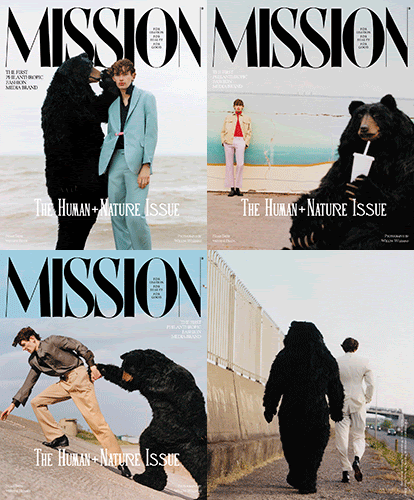
Homepage banner image, Bertrand Piccard ‘Selfie’ courtesy of Bertrand Piccard and Solar Impulse. This feature taken from the current issue of Mission’s Human & Nature issue. Homepage homepage image, The Balloonists, left explorer Bertrand Piccard and British flying instructor Brian Jones as they race to become the first to fly nonstop around the world in a balloon. Trailer courtesy of Dogwoof Productions.