


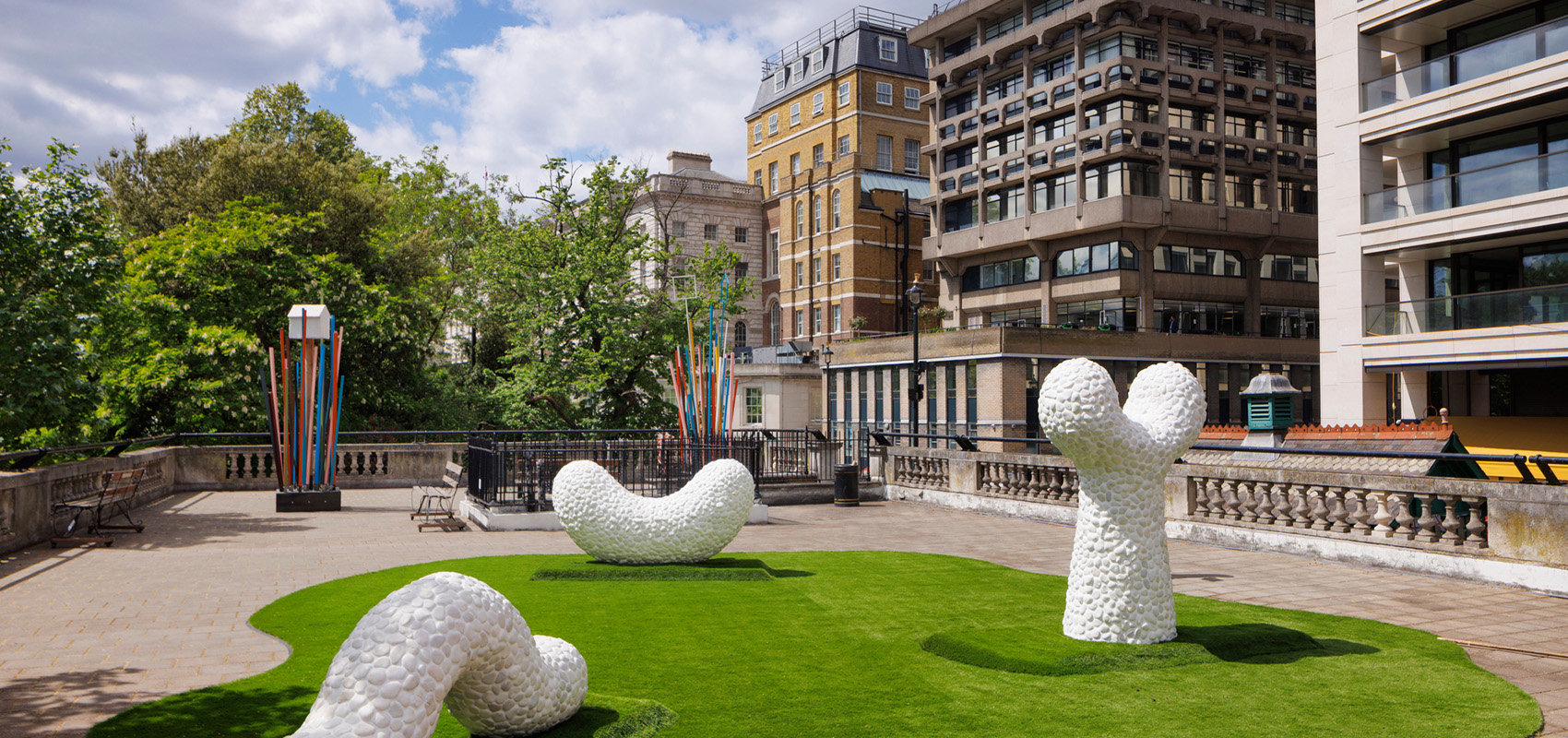
On their terrace nestled in the centre of London, The Artist’s Garden marks its fifth year with Sculpture in Three Acts: Peake, Linder, Monseignat, and launches a campaign to contest their eviction.
London’s only public sculpture garden, and the world’s first dedicated entirely to displaying the works of women artists, has recently celebrated their fifth anniversary — traditionally, and fittingly, signified with wood. In mid-May, around 100 people gathered at the Artist’s Garden — an unassuming 1400 sqm roof terrace atop Temple tube station overlooking the Thames — for the presentation of Sculpture in Three Acts: Peake, Linder, Monseignat and the launch of a campaign to fight the Garden’s eviction, due October 1st 2026.
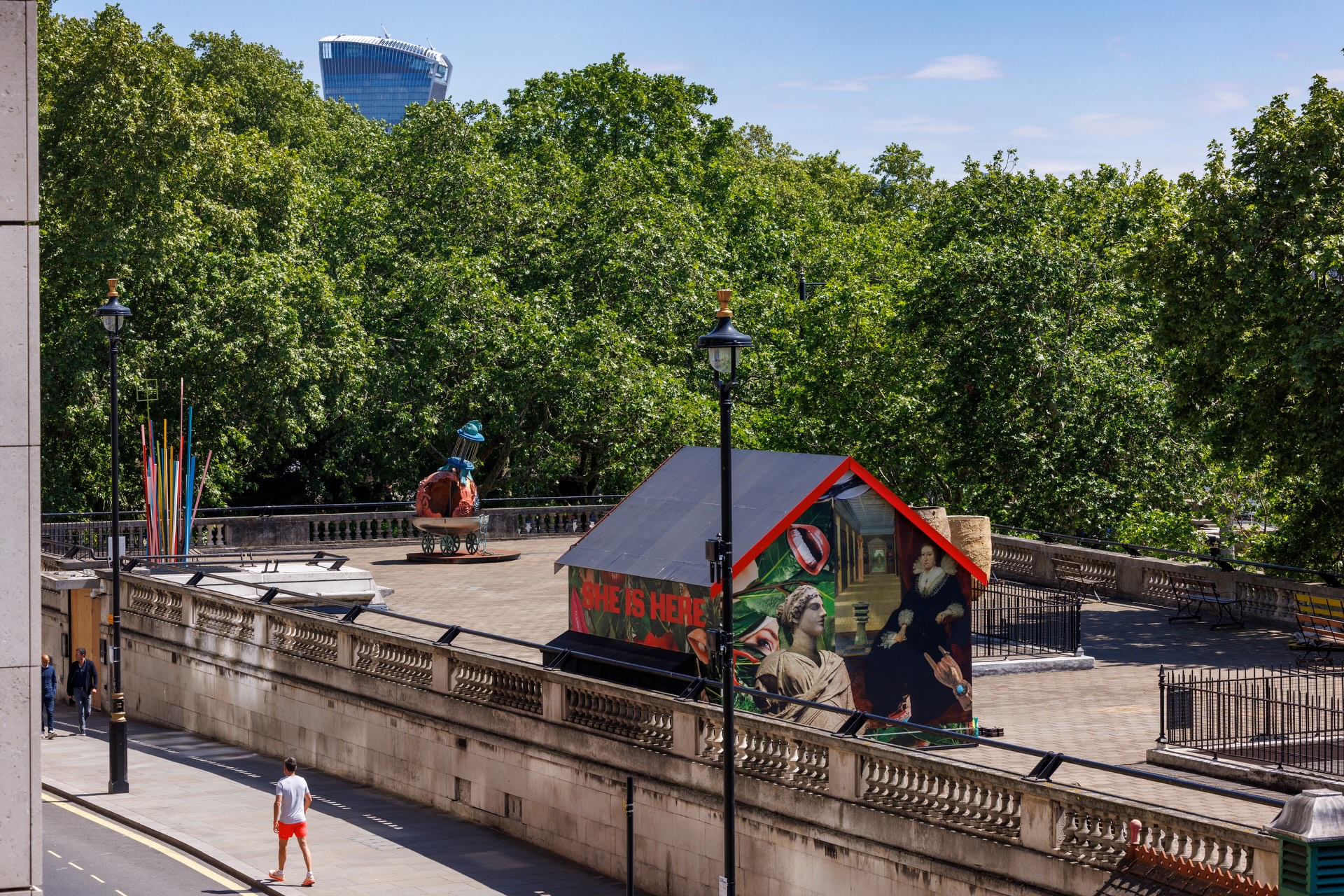
The Artist Garden’s latest exhibition reimagines their raised terrace as a stage on which the works are performed in dialogue with the National Theatre visible across the river. Sculptures by Florence Peake, Linder and Adeline de Monseignat, devised in response to the site have been gathered together into conversation through the frame of theatre.
theCOLAB, founded by Claire Mander, created The Artist’s Garden in 2021 with support from Westminster council. The project roots itself firmly into the soil of the site’s history. The Garden lies partially over the historic site of the 17th century sculpture gardens of Arundel House, the original location of England’s first classical sculpture collection created by Aletheia Talbot, Countess of Arundel (1585-1654) and her husband. The space not only has a long history as a sculpture garden, but as one shaped by feminine intervention.
Later, the site was formalised as public space for the people of London by parliamentary decree. This raised plinth forms part of the reclaimed land known as the Victoria Embankment Gardens. These were created by Sir Joseph Bazalgette in the 1860s to resolve the capital’s sewage crisis which had culminated in a particularly pungent summer known as the ‘Great Stink’.
For theCOLAB, the eviction notice served by Places for London feels ignorant to The Artist’s Garden’s rich dialogue with the history of this site and its extant cultural importance: ‘They don’t see the value of community or culture or seem to understand the nature of public space…We’re not going to put up with the obliteration of women’s work or the community of artists or of public space,’ says Mander.
The sculptures which populate the remainder of the Victoria Embankment Gardens spotlight the lack of gender parity within the arena of public art, a dearth that motivated the creation of the Artist’s Garden five years ago. Neighbouring the site Robert Burns, John Stuart Mill and Herbert Eaton are memorialized in stone, carved by male artists. Only 13 percent of London’s public sculptures are of women highlighting the broader underrepresentation of women in art.
This exclusion of women’s voices has created a situation in which women artists are from discouraged from aspiring to create large public sculptures. A myth still persists, Mander explains, ‘that women can’t or don’t want to make large things, or…make at scale for the outdoors, which is totally wrong.’ Joe Moran Rodrigo Peñalosa Pita
On the contrary, over the past five years, theCOLAB have found that many women artists posses a resourcefulness and communitarian attitude particularly well-suited to the setting of a public sculpture garden. The open outdoor setting of a sculpture offers a mode of encounter which lies in opposition the traditional patriarchal structure of a white cube gallery, with its attendant rules, boundaries and forms of control.

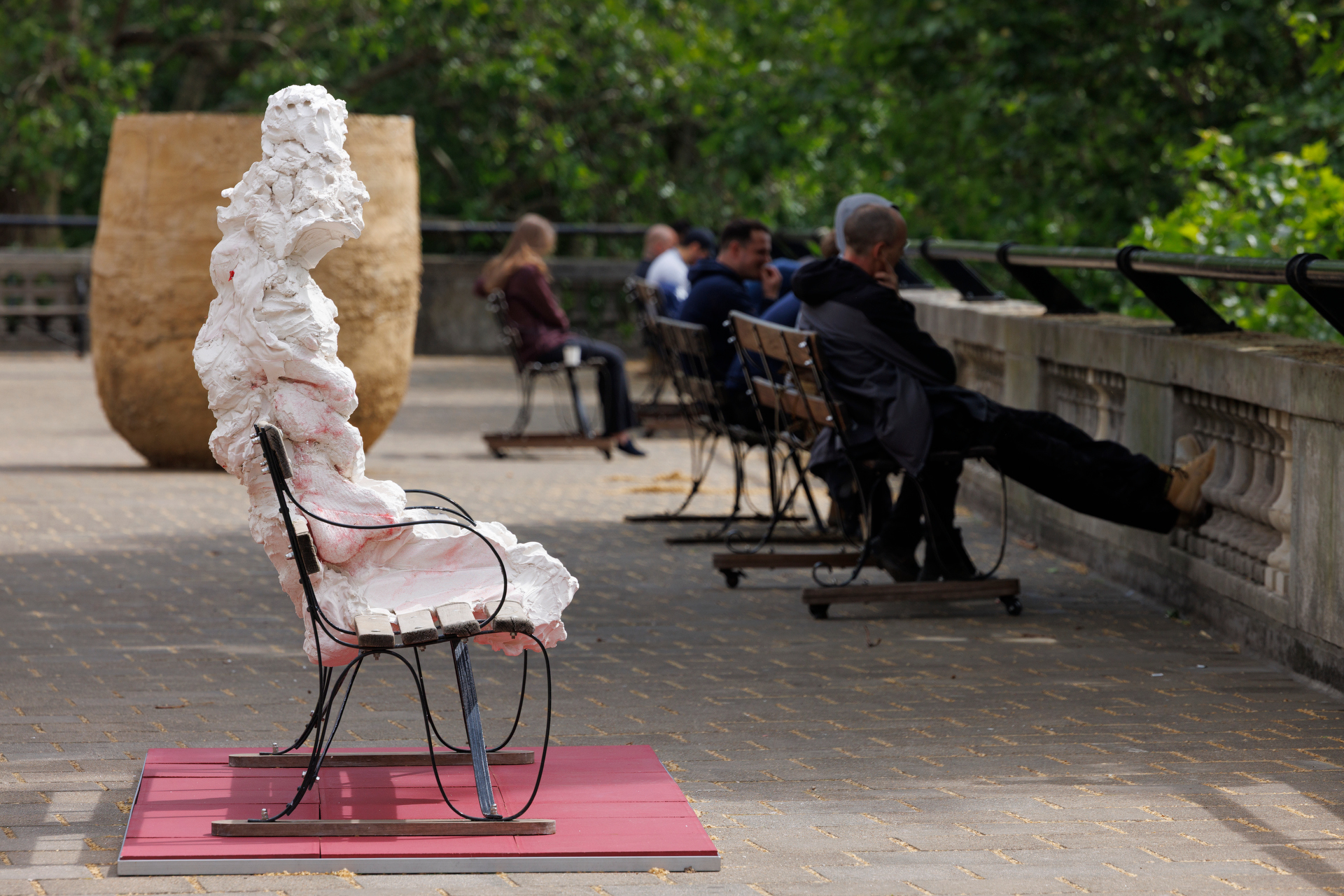
2026 commissioned by theCOLAB the Artist’s Garden, 2026. YMNYM Bench Kiss 2026, photo by Nick Turpin.
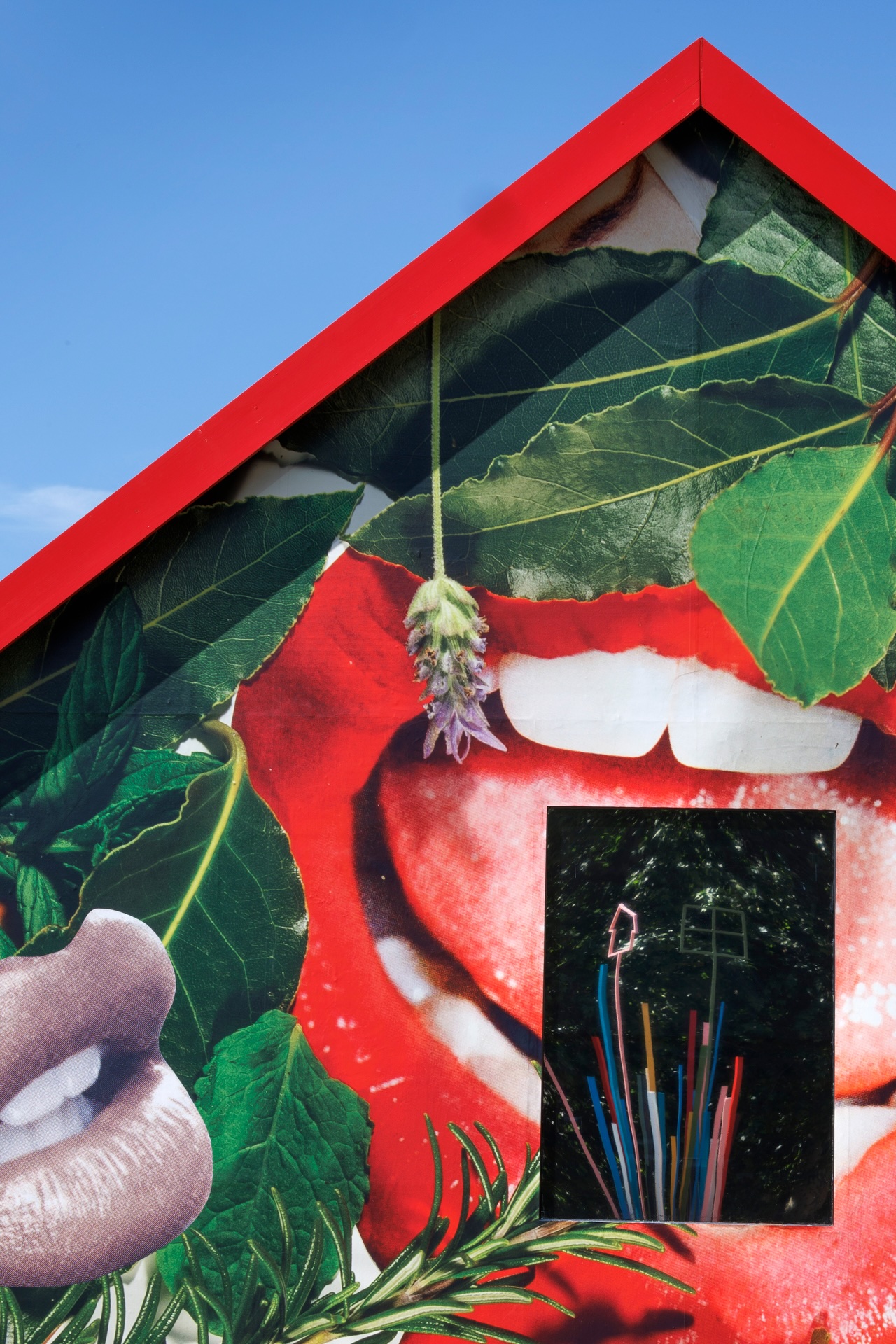
For Linder, whose pioneering, punk-feminist photomontage practice has challenged the classical gaze for fifty years, “The very existence of the Artist’s Garden signals defiance and hope on a global level…Art becomes balm” This sentiment was actualized in Florence Peake’s performance in which she casting the space between a kiss between two men, Joe Moran Rodrigo Peñalosa Pita, as part of her project YMNYM at the exhibition’s launch which coincided with a Tommy Robinson-led far-right protest: “We were wondering whether we should go ahead…There were people of colour in the performance. It was queer…We could see the flags dipping around the edges and hear them as we were performing…It felt very important to try and offer…a refuge, a counterprotest, a portal, a different kind of space to that facism.” Peake explained.
Gardens have often been associated with nurture, growth and care — spaces of material and intellectual cultivation. The Artist’s Garden extends this tradition. The Women’s Work commission is dedicated to supporting artists at a critical stage in their careers. Alongside this, the Yorkshire Sculpture Park / Royal College of Art commission enables women artists to realise their first large-scale public works.
Central to both is the opportunity to directly communicate with the public whilst inhabiting ‘The Artist’s Hut’ in the garden. One artist in residence described having to explain her work to both a professor of philosophy from King’s and a six-year-old child, elucidating the importance of communicating art beyond specialist audiences.
The Garden also partners with City Lions, a group for 13–16-year-olds across Westminster, many of whom are encountering cultural spaces for the first time, often leaving with a markedly changed sense of what art can be and who it is for.
This ethos of offering first-time opportunities is reflected in the artists commissioned in this exhibition. For Linder this represents the artist’s first three-dimensional outdoor architectural intervention, for Florence Peake, her first public outdoor sculpture commission, as well as Adeline de Monseignat first exhibition in outdoor public space. De Monseignant praises the garden as ‘a necessary vital platform within the wider contemporary art landscape’ expressing that “after years of feeling an urge to create pieces for the public realm, with the intent for the work to be accessible to all, I’m thrilled to gain that experience thanks to theColab, and to coincide with such exceptionally strong artists.“
At stake here, then, is not only a single site, but a broader understanding of who public space is for, of the histories it can hold, and of what it makes possible. As Derek Jarman wrote of his garden at Dungeness, “my garden’s boundaries are the horizon.”
Homepage image, left to right, Alice Walters, Linder, Claire Mander, Florence Peake and Adeline de Monseignat, photos courtesy of Henri T. Top image Adeline de Monseignat,Gusano, Croissant and Up-Up, 2025 at theCOLAB The Artist’s Garden 2026 by Nick Turpin. The Artists Garden is located on the roof of Temple tube station, London, WC2R 2PH. Opening times are daily, 8am till dusk.