


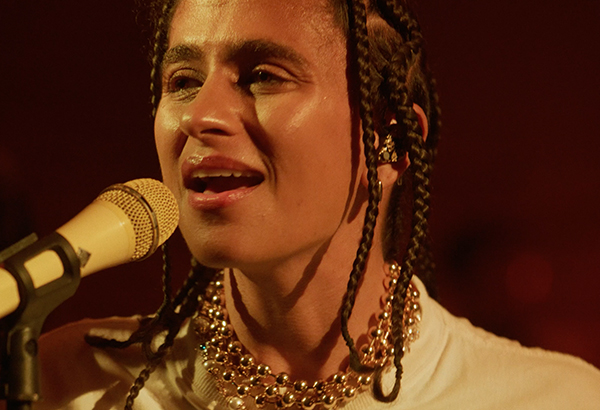
The spatial mix of the artist’s latest works brought immersive explorations of queer love, vulnerability, inner peace, and nature to life, while also foregrounding women’s leadership in the music industry.
To celebrate the release of her new album Love Letters From Brooklyn, Madame Gandhi returned to London to share a spatial mix of her recent work in L’Acoustic’s North London space. The sound system showroom, tucked away in residential Highgate, is outfitted with L-ISA in-wall loudspeakers, subwoofers, amplifiers, and processors that bring new dimensionality to Madame Gandhi’s already richly layered music.
The collaboration felt aligned on every level — technically, emotionally, and ideologically. The 37-year-old musician, known to friends simply as Kiran Gandhi, began her sonic career as a drummer and is still building an intricate architecture of percussion and vocals that was beautifully illuminated by the L-ISA technology.
“Only 2 percent of music in the world is produced by people who identify as women, so we’re really missing a big contribution.”
Gandhi’s two latest albums were both created in collaboration with exclusively women-identifying professionals. This ethos extended to this very spatial experience showcased at L-Acoustics’ showroom, which was mixed by audio engineer and doctoral researcher Marcela Rada, while the live audio was run by engineer Bella Cooper.
“Only 2 percent of music in the world is produced by people who identify as women, so we’re really missing a big contribution,” Gandhi said. “I really appreciate Marcela’s leadership in bringing more women into the immersive audio space, which is even more male-dominated.”
Her previous album, Let Me Be Water, which was also mixed spatially by Rada and presented at the showroom, was made in collaboration with We Make Noise (stylized as WMN), a music tech initiative focused on gender equity. The new album was created through a women-led collaborative songwriting camp in partnership with Gender Amplified, and centers on Gandhi’s tender reflections on queer love and intimacy.
“This one’s a lot more tender, but there’s also a lot of strength and confidence.” Although the two albums differ in narrative — the former blends environmental consciousness with mindful escapism, while the latter is inspired by the artist’s long-distance relationship — they are parallel in spirit.
“So often it’s been the activism that really motivates my heart and my romantic experiences, my love.”
“So often it’s been the activism that really motivates my heart and my romantic experiences, my love,” Gandhi said. “They both have the same energy — a devotion to this world to fight the good fight for causes that we care about, and a love that can be both healing and challenging, pushing you deeper into your own human experience.”
Gandhi has previously refrained from love songs, calling them “boring.” But as her Pisces sensitivity brought her to “feel it on a more spiritual level and reflect on personal growth by being in a relationship dynamic,” she decided to bring romance into the music camp, where she and her fellow women writers and producers channelled these sentiments into a full studio album.
Rada’s spatial mix and the L-ISA technology created a multi-dimensional, enveloping sense of presence, allowing layers of rhythm to breathe throughout the room in ways that mirrored the record’s themes of closeness, vulnerability, and human connection. “Even though [the album] wasn’t composed or produced for a spatial environment, when I listened to it, I knew immediately that it had all the potential to become this experience,” Rada said.
Sounds of nature are also a recurring motif in Gandhi’s creative practice. Both Love Letters From Brooklyn and Let Me Be Water include tracks that feature Nature as an artist, with a portion of the streaming royalties redirected back to the planet.
Gandhi recalled her first week at Stanford University as a Music, Science, and Technology Master’s student, where she learned to construct underwater microphones and recorded whales singing in Monterey Bay. For the track “Let Me Be Water (feat. NATURE)”, she later travelled to Antarctica to capture the sound of melting icebergs using the same technique.
“I can really take this same concept and actually record the sounds of climate change — the sounds of our planet literally melting,” the artist said. “It’s the most tragic and beautiful sound at the same time.”
Rada’s spatial mix and the L-ISA system transformed the listening room into an almost submerged environment, where the crackling, bubbling, and sizzling sounds of air escaping melting ice moved fluidly throughout the space alongside Gandhi’s spoken mantras and vocals. The immersive presentation accentuated textures and environmental details in a way that conventional stereo could not, creating an experience that felt less like listening to a recording and more like inhabiting a fragile, shifting ecosystem.
“I think it’s really important for us to use technology like this intentionally — we can mix it spatially, but does that actually create an amplified and heightened emotional experience for the listener?“
“I think that’s one of the things you can imagine when with immersive audio: you can transport the listener to a specific environment, somewhere where you would never actually be able to experience,” said Rada. “In this case, it was nature, but it’s also about hearing nature around you and being in both spaces at the same time.”
In a room championing equity and humanity through technology, Gandhi also redirected the focus to the human aspect of creativity. “I think it’s really important for us to use technology like this intentionally — we can mix it spatially, but does that actually create an amplified and heightened emotional experience for the listener?” she asked. “It’s like we’re gonna create, and we’re gonna utilize these tools, but let’s optimise for what we as humans do best, which is create connection, heart, emotion.”
All images courtesy of L’Acoustics, courtesy of Steven Lee Busby.