


Mission spoke to some past students of navigating life after leaving the support network of a college life.
Graduation has always been sold as a beginning. It marks the end of late-night deadlines, crits and dissertations, and the start of something bigger. Universities promise industry connections, social media feeds us carefully curated success stories, and London is imagined as the place where talent inevitably finds opportunity.
The reality is far less cinematic. For many emerging creatives, life after university is defined less by breakthrough moments than by endurance: balancing creative work around full-time jobs, chasing opportunities and questioning whether a career built on passion can also provide stability.
My name is Jesse, and I studied BA Fashion Journalism and Content Creation at UAL. After graduating this year, I thought my biggest challenge would be finding work. Instead, I found myself adjusting to an entirely different way of living. For three years, university had given me structure, deadlines and constant creative stimulation. Then, almost overnight, it disappeared. There were no tutors, no weekly feedback sessions and no clear roadmap for what came next. Like many graduates, I wasn’t just searching for employment. I was trying to understand what being creative looked like outside education.
Over the past few weeks, I spoke to another recent graduate, photographer David Lammond, who studied at UAL and graduated last year with a BA in Creative Direction for Fashion. Creative director Jaydyn Ajadi, who studied Fashion Journalism and Content Creation at UAL and graduated last June; Maddie Dinnage, who studied BA English Language and Literature in 2023 and an MA in Social Justice Journalism at The University of Nottingham and graduated this year; and creative publisher Anderson Shao-Wei Hung, who studied BA Fashion Journalism at CSM and graduated in 2025 , about life after graduation. Their careers have taken different paths, yet every conversation returned to the same questions: How do you sustain a creative career in one of the world’s most expensive cities? What happens when passion becomes your livelihood? And who gets the opportunity to pursue it?
“The majority of roles offered are unpaid, or offer small fees and are heavily fought for.”
David Lammond
The biggest misconception surrounding London’s creative industries isn’t that opportunities don’t exist. They do. The real question is who can realistically afford to pursue them.
“Well, I’m certainly not going to sit here and say the opportunities aren’t there, because they are,” Lammond tells me. “But for many there are too many limiting factors to make sustaining a creative profession possible.”
“The majority of roles offered are unpaid, or offer small fees and are heavily fought for,” he explains. “For those who can afford to take unpaid internships, sacrifice their time for small-fee jobs or create out of their own pockets frequently, I’d say it’s subjectively fruitful.”
For Ajadi, the problem is partly one of saturation. “While yes, there are many opportunities,” he says, “the sheer saturation of the industry sadly makes it seem as if there are not.”
And when opportunities are so competitive, talent alone may not be enough. “You have to be well-connected and well-respected,” Ajadi says. “Talent is not everything. It is survival of the fittest.”
For Hung, that competition is compounded by barriers beyond the industry itself. As an international creative, the need for future visa sponsorship can immediately exclude him from positions, while he also lacks the networks that people who grew up in London may already have.
“Uni was such a diverse environment that it gave a false illusion of what being a creative in London looks like,” he says.
Maddie Dinnage recognizes another contradiction. London remains one of the most creatively vibrant places she has experienced, but turning that inspiration into a financially sustainable career is another matter.
“In terms of creative inspiration, London is one of the most incredible and vibrant places,” she says. “But in terms of ways to turn that inspiration into something that is financially sustainable, it’s actually surprisingly really difficult.”
For Dinnage, the reality has meant working full-time as a data administrator while continuing to apply for creative roles.
“When you’re working full time, it can be really energy draining,” she says. “I find it really hard to then feel creative because creativity does take a lot of brain energy.”
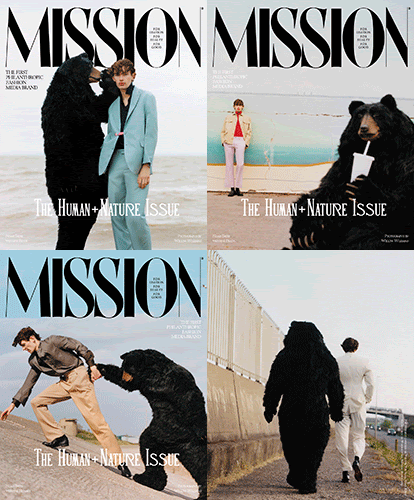
The adjustment isn’t only financial. Dinnage says one of her biggest challenges has been losing the sense of creative direction university provided. Yet continuing to create has also become a way of remembering why she wanted a creative career in the first place. Writing for the latest print edition of Mission Magazine reminded her of her passion for journalism and the importance of making time for her creative practice.
For Hung, work outside his main practice has become another way of navigating the uncertainty. He has taken on paid work in translation, research, graphic design and film production. Rather than seeing these as distractions, he considers them part of an interdisciplinary creative practice.
“Shared value and meaningful collaboration keep me going and remind me of the importance of my work.”
Anderson Shao-Wei Hung
The same tension appears in Lammond’s experience. He works a full-time management role to finance his photography, editing on lunch breaks and planning shoots around the few hours left at the end of the day.
Different experiences, but the same underlying tension: protecting your creativity while simultaneously depending on it to survive.
For Hung, community has become an important part of doing so. “Shared value and meaningful collaboration keep me going and remind me of the importance of my work,” he says.
That community is also shaped by cost. Hung currently runs a zine collective with other creatives, where pricing their work means balancing exposure, accessibility and their audience’s ability to pay. “A lot of the time we have to compromise to cut costs,” he says.
Perhaps the biggest adjustment after graduation isn’t learning how to make money from your creativity. It’s learning how to stop money, access and survival becoming the only reasons you create. As graduates, we can become so used to creating for a price, an opportunity, or simply to survive that, without those things, we lose the motivation to create at all. But creativity existed before it became a career.
As children, we created because we were curious, not because there was an audience, a deadline or a payment waiting at the end of it. Perhaps we need to return to that instinct and remember that not everything we make needs a price, a label or a purpose beyond ourselves. Creativity is a gift, and sometimes we have to allow ourselves to create simply because we want to.
One piece of advice stayed with me long after these interviews had ended. Reflecting on a conversation Lammond had with Luca Federico, Head of Art Direction at Miu Miu and Prada, Lammond shared the words that reshaped his own perspective:
“We should all be more actively curious and be less passive in the media we choose to consume, spend less time on Instagram and pick up a book. Find inspiration anywhere but on your phone.”
The more I thought about it, the more I realized that curiosity is perhaps the one thing worth protecting above everything else. In an industry increasingly driven by algorithms, productivity and personal branding, curiosity asks us to slow down. To make something without immediately asking whether it will perform well, attract clients or become profitable.
Uncertainty isn’t a personal failure; it’s become part of building a creative life today. We are encouraged to turn our passions into professions, our hobbies into businesses, and our creativity into content. But perhaps the greatest challenge isn’t learning how to make a living from what we love.
It’s learning how to protect the part of ourselves that loved making it in the first place.
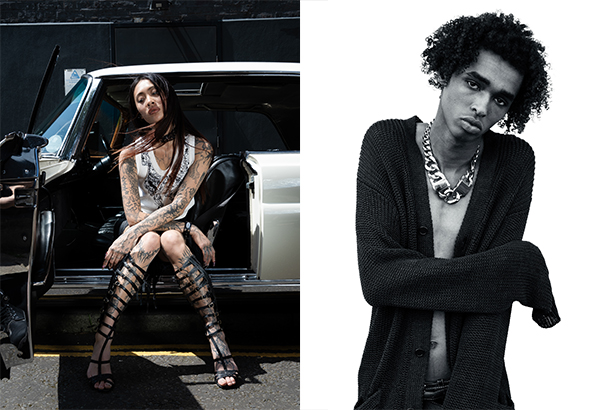
Homepage image Maddie Dinnage, image courtesy of Dinnage. Inside image left, Inès Photographed by David Lammond, and right image Hazz wearing Ys by Yohji Yamamoto.