


AI artist Refik Anadol uses data as a paintbrush, transforming environmental patterns into striking depictions of the natural world.
The natural world moves in cycles—the moon and tides in everlasting iteration, the birth and decay of all living creatures, ecosystems in constant flux. Certain inputs produce particular outcomes—light and water bring growth, species evolve to their surroundings. In fact, the patterns, repetitions, and changes of nature are not too dissimilar to the behaviors of data and code.
It is here, at this intersection, that the data artist Refik Anadol has developed his practice, creating vibrant and immersive installations, paintings, and NFT collections based on the data patterns of nature. With the aid of nature-informed AI models, Anadol visualizes the unseen rhythms of Earth, bringing together the forces of art, nature, and technology.
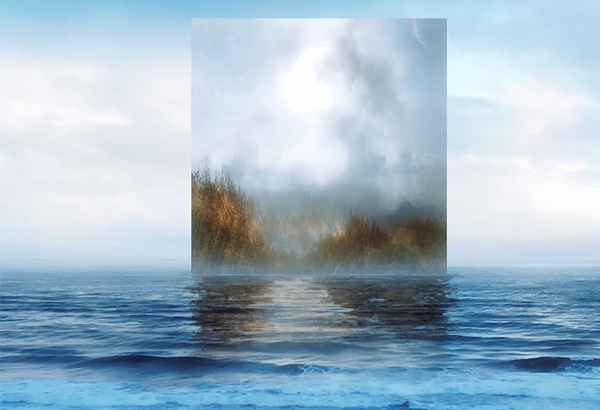
Anadol leverages tools such as lidar (light detection and ranging) and photogrammetry to inform his Large Nature Model (LNM), the world’s first open-source AI model trained solely on ethically collected nature data. This data is used to generate breathtaking landscapes and organic textures inspired by real-world flora and fauna, projected onto wraparound installation walls. Viewers are enveloped in deep forest greens and vibrant coral reds, surrounded by moving visuals that melt seamlessly into one another and are accompanied by natural soundscapes. “I believe when we are surrounded by these artworks, which appeal to us through sound, through smell, through visuals, I think it’s a new form of art that we are not used to.”
Anadol grew up in Istanbul, Türkiye, where the Bosphorus unites the Black Sea with the Sea of Marmara; it’s an inspiring city, where two continents connect. Among the sprawling hiking trails of Belgrad Forest, just north of the city, and the rich mosaic of local wildlife, Anadol’s deep fascination with nature took root, later forming the basis of his practice.
At the age of eight he acquired his first computer, and through that small screen he saw a wealth of imaginative possibilities, endless virtual realities just waiting to be made tangible.
“I was super-inspired by the idea of a machine as a collaborator or friend, the gamer mindset,” he says. “I understood that world-making is possible—through computation, through algorithms, and by coding.” Anadol developed an eye for innovative architecture and felt frustrated with the archaic, static processes of construction that dominated his immediate environment. “From an early age, I knew that the future of architecture could be much more inspiring than concrete, glass, or steel,” he says. In the artist’s adolescent mind, the future was populated with buildings and structures that were dynamic and ever-changing, with walls and ceilings that transformed organically, much like elements of the natural world.
“From an early age, I knew that the future of architecture could be much more inspiring than concrete, glass, or steel.”
Anadol went on to study digital communication design in Istanbul before relocating to Los Angeles, where he gained a second MFA in design media arts at UCLA. While his interest in architecture progressed naturally into a passion for digital media, his focus remained anchored by a desire to unite technology with the natural world.
“In 2008, I coined the term ‘data painting,’” he says. “I was interacting with data as a form of pigment that doesn’t need to dry and doesn’t need to worry about Newtonian physics. I don’t know the feeling of using a chisel or brush—these tools were invented hundreds of years ago with a different mindset. But in my lifetime I witnessed the birth of the internet, of quantum computation, of AI. I saw this evolution of a new art form and I felt a connection with it.”
He cofounded Refik Anadol Studio in 2014, a pioneering collective in the development of machine-assisted aesthetic production. In the past decade, Anadol and his team of 20 leading artists, architects, designers, and data researchers have partnered with several of the world’s leading technological institutions, such as Google, Apple, Intel, NASA, Harvard, and MIT, to form a rich understanding of the creative possibilities of artificial intelligence.
“After we opened our studio, I was very fortunate to become the first artist in residence at Google’s AMI [Artists + Machine Intelligence] program,” Anadol says. “Ten years ago, AI was nothing like it is now, but at its center, it was a thinking brush, with the opportunity for human collaboration.”
Through his residency at Google, Anadol learnt to harness the power of AI and developed a focus on nature-driven datasets. He observed wind patterns, water temperatures, and air quality, and perceived a natural symmetry between the rhythms of nature and the worlds of data and technology in which he had immersed himself.
For him, a number of complex questions emerged. What if technology could learn from the processes of nature? Could code mimic the fluidity of water or the turbulence of a windstorm?
And, if so, could we use that data to create a visual spectacle that builds a deeper connection between people and the planet? Through combining data with artistic expression, he endeavored to find out.
Anadol’s machine-assisted artworks, installations, and performances have been shown at some of the world’s leading cultural institutions. In 2022, the Unsupervised installation at MoMA in New York City was created using a dataset of more than 138,151 pieces of metadata from the museum’s nearly century-old archive of modern and contemporary artworks. From Marcel Duchamp’s Bicycle Wheel to Andy Warhol’s Campbell’s Soup Cans, every photograph, painting, sculpture, and film in MoMA’s collection was used to train a detailed machine-learning model and projected onto a large screen. Visitors could witness the creation of imagined art in real time, with light, sound, and visuals in constant movement, exploring the machine’s capacity to “dream” and “hallucinate.”
Alongside its large-scale collaborations, Refik Anadol Studio has become a leading voice in blockchain technology, presenting in 2021 Machine Hallucinations — Space: Metaverse in a physical exhibition in Hong Kong with a simultaneous NFT collection that was auctioned at Sotheby’s and included an immersive digital artwork experience. Subsequent pieces have been projected in locations such as New York City’s Rockefeller Plaza and Gaudí’s famous architectural feat Casa Batlló in Barcelona. Through direct sales of these NFT collections, the studio has raised more than $10 million for charitable causes, including UNICEF and the Alzheimer’s Foundation of America.
However, with great technological power comes great ethical and environmental responsibility, particularly when using vast supplies of energy to power large-scale installations.
“Five years ago, I met with some of the most incredible people that I have ever known—the Yawanawá family, who are living in the rainforest of Amazonia.”
“AI has lots of fears and hysteria. People are questioning ethics, rightfully, people are questioning free will and energy consumption,” Anadol says. “As a society in general, the discovery of new technologies generally starts with a privileged point of view. It is not wholly inclusive, and as it grows, it becomes something for anyone and everyone.
“Three years ago, when large language models arrived, they were super-behind. They didn’t know nature. They were hallucinating a lot, they were making up names. If AI fundamentally doesn’t understand nature, we have a problem.”
At the intersections of art, nature, and technology, Anadol saw endless creative potential, and to bring that potential to life, he required mentorship. “Five years ago, I met with some of the most incredible people that I have ever known—the Yawanawá family, who are living in the rainforest of Amazonia,” Anadol says. “They became my teachers and they have been influential in encouraging me to look at nature differently, to understand what it really means to live among nature for thousands of years.”
Through close collaboration with the Yawanawá community, Refik Anadol Studio blended a comprehensive understanding of AI models and data points with Indigenous knowledge systems to create the Winds of Yawanawa collection, an NFT series of 1,000 digital paintings and three data sculptures. The pieces were generated using rainforest-weather data captured within Yawanawá territory, including wind speed, direction, and temperature changes, combined with drawings by young Yawanawá artists. The result? A rich depiction of the community’s history, culture, and deep-rooted relationship to the natural world.
“The reason behind this collaboration was that the chief, Nixiwaka, had a dream to create a cultural center in the heart of Amazonia where he could host hundreds of other families of the forest, to bring them together and form communities,” Anadol says. The funds generated by the collection were deployed by the Yawanawá chiefs to build sustainable infrastructure in the village of Aldeia Sagrada and to develop educational curricula within the Nova Esperança community.
The connecting thread that weaves together more than 10 years of Anadol’s work is the desire to take complex, abstract concepts—nature, humanity, artificial intelligence—and translate them into something visual, emotional, and experiential. In the late 1800s, Monet pored over his water lilies with painstaking attention to detail. Today, Anadol yearns to visualize every water lily in the world. For the data artist, these are not two different feelings, merely different timings. “AI art is truly allowing me to dive deep into these feelings. These perceptions cannot happen with our eyes, with our ears, with our brains alone,” he says. “This really requires a collaboration with machines.”
The studio’s latest—and perhaps most ambitious—venture is Dataland, the world’s first museum of AI arts, opening on June 20 at The Grand LA. Set to become a permanent fixture in the cultural epicenter of Downtown Los Angeles, Dataland will use pioneering immersive and sensory technologies to exhibit a wide collection of digital art pieces.
Dataland’s exhibits will be constructed using Refik Anadol Studio’s LNM. By integrating digital art and environmental science, the LNM seeks to elicit a collective call to environmental action, engaging visitors through multisensory experience and powerful visuals. “I feel that we are navigating a whole new ocean, and we’re yet to discover where it meets the land. It’s a fascinating journey, and I see incredible potential,” Anadol says. “I see the power of programming and coding with AI, and within that there’s this abundance of creativity, of computation.”
As AI developers continue to push the boundaries of powerful technologies, Anadol is determined to keep ethical sustainability at the forefront of his practice. “Things can go wrong, of course, but this technology is a mirror for us. Bad actors always exist, but we have a lot of goodness. I hope we stay on the good side of the world.”
All images courtesy of Refik Anadol Studio.