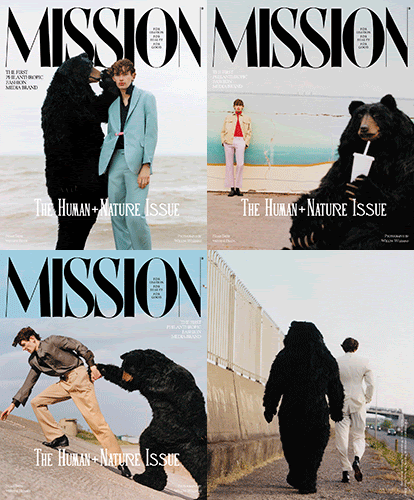



Recently voted as one of the greatest living American songwriters by the New York Times, Nile Rodgers, co-founder of We Are Family Foundation, guest edited Mission’s past New Order youth issue. Catch the interview with Craig McLean below.
From high-impact songs to a high-impact foundation, Nile Rodgers has spent a lifetime creating meaningful moments in people’s lives. In this wide-ranging interview, he covers the joy of creation, the value of doing good, and iconic moments from five decades of musicianship.
Why is Nile Rodgers here? Here, as in: within the pages of this magazine. Over them, too, as guest editor for our issue in celebration of The New Order.
We ask because, well, at the age of 72—after a gilded, half-century-spanning, genuinely epochal career working with CHIC, Sister Sledge, Diana Ross, Duran Duran, David Bowie, Madonna, Daft Punk (the list goes on) (and on)—the man is still as busy as ever.
In 2024 alone he has released a single “For Life” with Kygo and Zak Abel (4.6 million YouTube views); another single, “Honey Boy,” with Purple Disco Machine, Benjamin Ingrosso, and Shenseea (56 million Spotify streams); and another single, “This Is the Moment,” with Son Mieux (350,000 streams). He played guitar on a charity rerecording of the former Dire Straits frontman Mark Knopfler’s “Going Home: Theme of the Local Hero,” released in aid of Britain’s Teenage Cancer Trust and Teen Cancer America. He produced “Electric Energy,” the closing credits track on Matthew Vaughn’s spy caper Argylle, which also featured Ariana DeBose and Boy George.
“It’s tricky, because I can’t really tell. I just know that a lot of the young artists that I work with now inspire the hell out of me. But I can’t tell if their world [is the same]. I can’t tell if they’re going to have the same kind of experience.”
His production work has appeared on new albums from the British indie band The Zutons, English singer-songwriter Alfie Templeman, J-Hope of K-pop juggernauts BTS, and Beyoncé, his work on her Cowboy Carter coming in the wake of the two Grammys he received for his contributions to her last album, 2022’s Renaissance.
Then, three days after we meet, comes the release of another Rodgers-featuring track. “All Eyes on Us” is the debut single from as1one, a boy band billed as “the world’s first mixed Israeli Jewish and Palestinian Arab pop group.”
In an issue dedicated to a new generation of artists and changemakers, then, Rodgers stands as a GOAT, thoroughly immersed in the creativity of peers, near-peers and younger talent. As best he can tell, how does he think starting out now in music compares to how it was for him starting out in New York in the early 1970s?
“It’s tricky, because I can’t really tell,” comes his truthful response. “I just know that a lot of the young artists that I work with now inspire the hell out of me. But I can’t tell if their world [is the same]. I can’t tell if they’re going to have the same kind of experience. Because when I started, you had to work with other people. An artist who worked alone, they were unique and strange and weird. But sometimes they were really great storytellers. In my way of composing, being in the business, you totally had to rely on the skills of other people. It was really important. So, in a way, today’s world is more exciting.” Meaning: today’s technology empowers young artists to go it alone, from their bedroom, their laptop, even their phone. Whereas in Rodgers’s day, making music meant getting access to a music studio, where “a recording console looked like you’re trying to fly an airplane!”
So collaboration was necessarily baked into Rodgers’s musical DNA from the off. He still creates in that spirit, as evidenced by these recent projects. And, for the myriad previous achievements that led to those releases this year, Rodgers recently received the World Economic Forum’s Crystal Award and was named a Polar Music Prize Laureate by the Swedish music industry.
“I love Mission’s spirit. I love where you’re coming from. People who live to do good are just so special. And when you have a mission like Mission, it’s a wonderful thing, man. So I want to do everything I can possibly do to be involved—and to make Mission’s mission a part of my mission.”
Say it again: all these records and gongs appeared this year. How has the guy got time to be working on this magazine?
Because it’s important.
“I love Mission’s spirit,” the songwriter, producer, guitarist, band leader and philanthropist says. “I love where you’re coming from. People who live to do good are just so special. And when you have a mission like Mission, it’s a wonderful thing, man. So I want to do everything I can possibly do to be involved—and to make Mission’s mission a part of my mission,” Rodgers says with that room-lifting, gap-toothed smile.
That, he adds, is enhanced by the fact that there’s already congruence and overlap by what we’re doing and what he and his partner and fellow co-founder Nancy Hunt are doing with their We Are Family Foundation. Per their website, it’s a nonprofit organization—named, of course, for the 1979 U.S. No. 1 that Rodgers and his late CHIC partner, Bernard Edwards, wrote and produced for Sister Sledge—“that’s dedicated to the vision of a global family by creating and supporting programs that promote cultural diversity while nurturing and mentoring the vision, talents, and ideas of young people who are positively changing the world.”
Sipping a glass of water, stylin’ Nile—a vision in a paisley headscarf, pale-blue dinner jacket, blue candy-stripe shirt, faded flared gray jeans side-zipped high-to-the-thigh, white slip-ons, three strings of pearls and Chanel shades—settles into a sofa in the lounge of a hotel hard by Hyde Park, central London, a five-star joint that is his preferred pied-à-terre when he’s in the city.
“I’ve always lived to try to enhance the spirit and the penetration of art in the world. And you know, I certainly believe that fashion is art,” he continues, nodding to the other heartbeat of Mission. “I was just saying that to someone the other day. Sometimes it’s our best form of expression, the way that we represent ourselves. I know a lot of people [for whom] that’s just their vibe, and their style feels like art to me.”
“Speaking of vibe and style,” I say, “those jeans are killer. Where are they from?”
“I don’t know!” he says with a gravelly chuckle. “I’ve had them for quite a while. [Clothes are] just part of my makeup. My parents were very into fashion. Even my grandmother used to always say to me things like, ‘If you want to get ahead, get a hat!’ They dressed me when I was a little kid. They wanted me to look more like an adult, which I thought was weird! But it definitely had an effect on me. I don’t remember who exactly the great jazz musician was, but he was being interviewed. They asked him why he dressed the way that he dressed. Why did he seem to care about his fashion statement so much? And he said, ‘Well, before they hear you, they see you.’ And it was like, ‘Wow. Okay. I get it.’”
Why, too, is Nile Rodgers here—as in London? Something to do with the imminent European premiere, at this fall’s London Film Festival, of Pharrell Williams’s biopic Piece by Piece? It brilliantly tells the story of that other multi-hyphenate in animated Lego form, and there’s a walk-on for Rodgers, also rendered in Lego, in a scene where he and Williams perform with Daft Punk their collaborative 2013 smash, “Get Lucky.”
No, his visit is unrelated, and Rodgers hasn’t seen the film. Nor was he consulted on whether he was down with being visualized in knobbly-brick form. “And if they did, I would have said yes instantly. I certainly believe Pharrell is an artist par excellence. Sometimes my manager gets a little upset with me, because anybody who wants to use my music and reinterpret it and stuff like that, I always say yes.”
“The one thing I love just as much as playing music is meeting the people from all cultures and creeds. I learned very quickly that we are all more alike than not.”
He might be here, in London, in connection with a screen dramatization of his own life story. He’s adapting it from his eye-popping, beautifully written 2011 memoir Le Freak: An Upside Down Story of Family, Disco, and Destiny. That’s being made in collaboration with a U.K. production company. Not unreasonably, he’s keeping details light, but he will say that it’s “collaborative. Our concept right now—we’ve had a couple of great meetings—is a scripted series. That seems to be the best way to interpret it. The best way to tell the story. Simply because the story is long, and it’s still going on. [Co-writing] is probably the best way I can contribute, because they like the way I write. So we’ll see.”
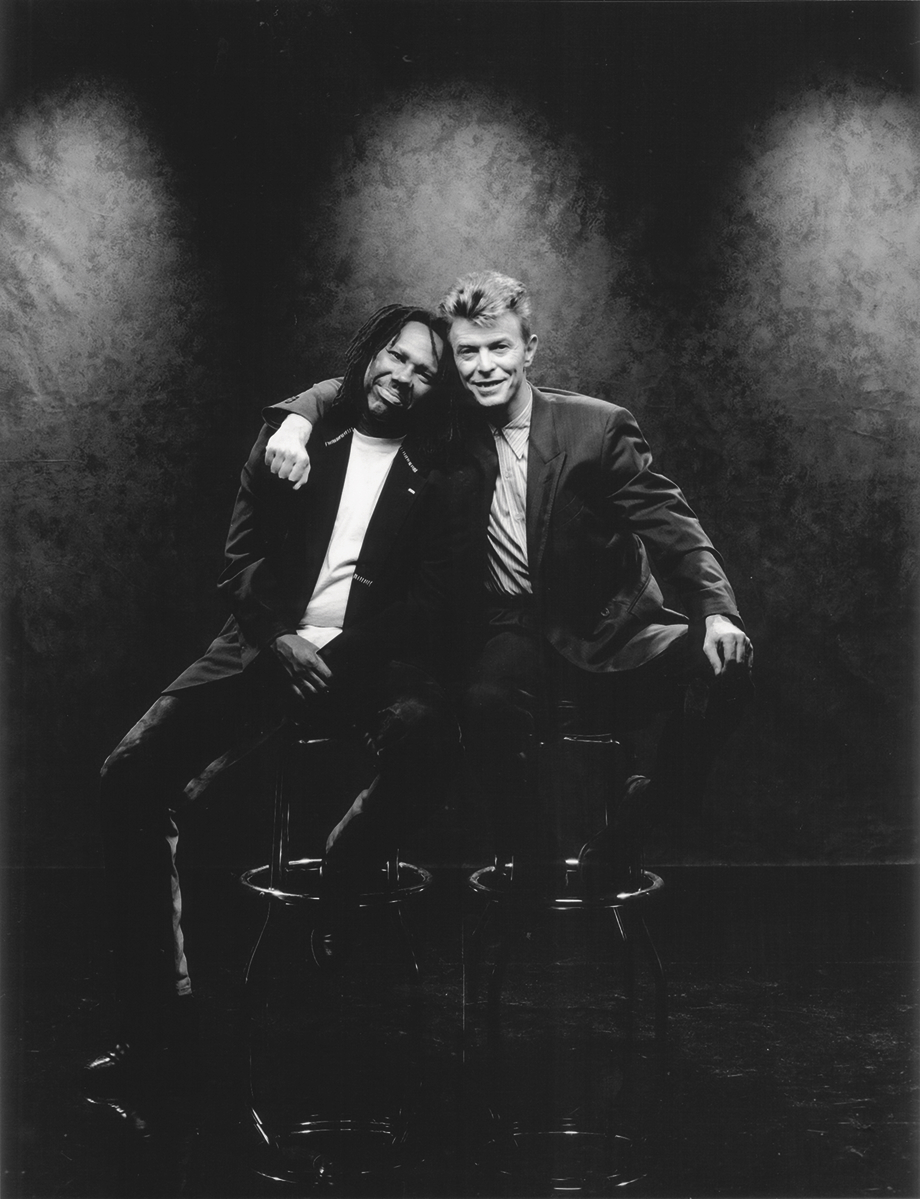
Nile Rodgers and David Bowie. Photo by Peter Gabriel.
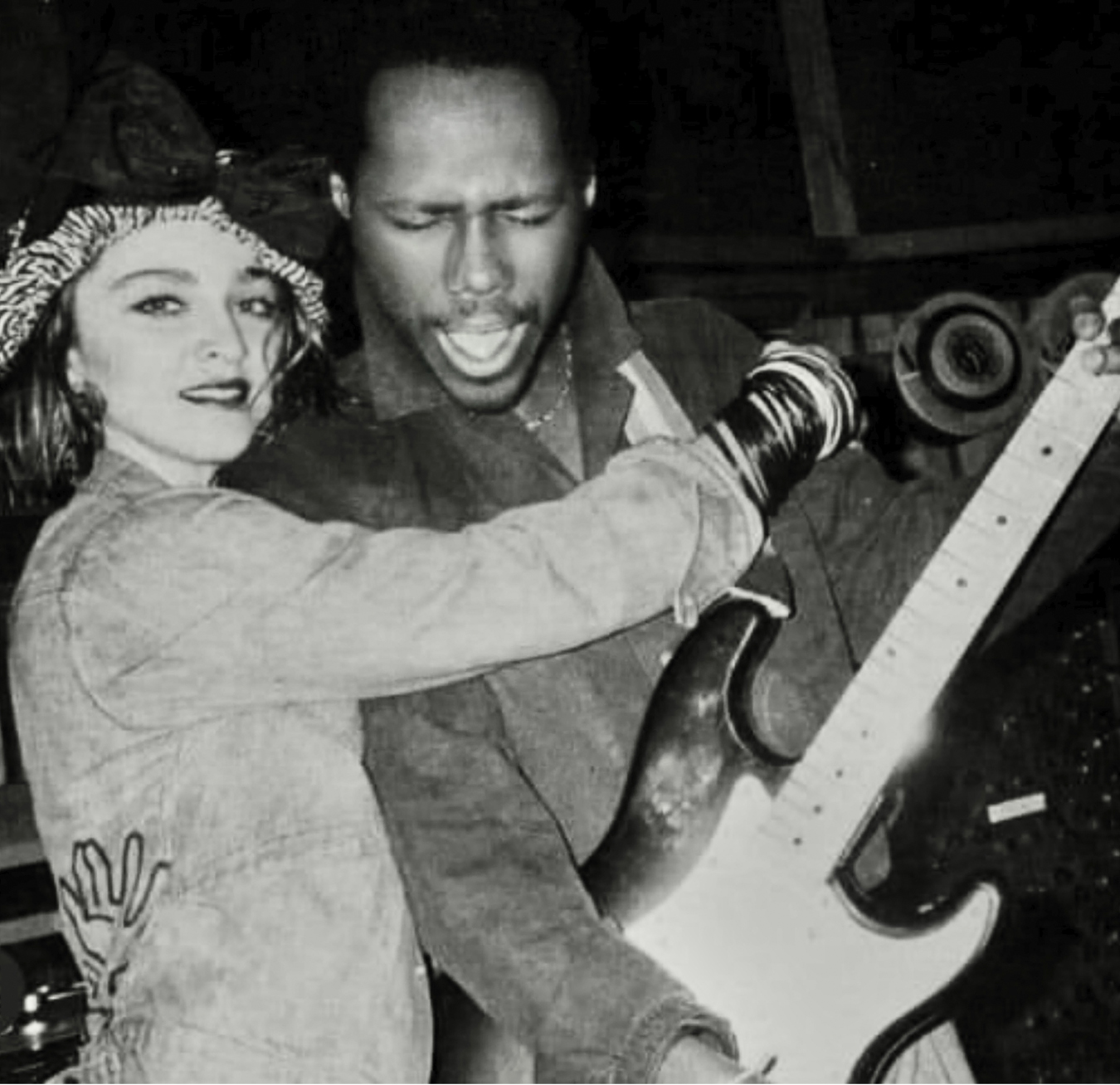
Nile Rodgers with Madonna, 1984. Photo courtesy of Nile Rodgers.
Long, and still going on. The story of Nile Rodgers is certainly, vividly, peerlessly both of those things. He’s been making music for over 50 years, and he’s playing that music still. Which, ultimately, seems to be the key reason he’s here in London—it’s a geographical staging post between two poles of his ongoing activism as a performer with a platform.
He arrived this morning from Paris. The day before, Rodgers and Gabriela Ramos, UNESCO’s assistant director-general for social and human sciences, signed a Memorandum of Understanding at UNESCO’s headquarters in the French capital.
“UNESCO and We Are Family Foundation share a common mandate to foster global youth leadership and combat all forms of discrimination,” Ramos said in a statement. “Together we’ll be stronger in bridging gaps between cultures and peoples, and I look forward to this partnership.”
“I have been a musician since I was a child, performing for audiences from every corner of the globe,” Rodgers said in his statement. “The one thing I love just as much as playing music is meeting the people from all cultures and creeds. I learned very quickly that we are all more alike than not, and that young people are the key to humanity’s future. I am beyond proud of the partnership between We Are Family Foundation and UNESCO, because we believe that problems that span generations require leadership that does too.”
As the UNESCO website elaborated: “Inspired by UNESCO’s commitment to inclusion and WAFF’s dedication to youth empowerment, the collaboration will leverage both organizations’ expertise to support young leaders, and address racism and discrimination through joint initiatives.”
Onwards, ever onwards: From London, the musician is traveling to Asia, the next leg of a global Nile Rodgers & CHIC tour that began in May. Next up: Malaysia, Thailand, Japan, and South Korea, before the run loops back to the States, then returns to the U.K. in November to close out the year’s performances. One of those will be in Liverpool as part of the Act 1.5 series, which aims to radically decarbonize the events industry, headlining the weekend-long series alongside Massive Attack and Idles. I ask this septuagenarian with indefatigable drive whether he has any advice for younger people—artists, activists, anyone—who maybe need some of his galvanizing energy and confidence.
“See, I’m idealistic,” Rodgers begins in his low, thoughtful rumble. “And I believe in things that may not be true,” he adds, smiling. “So I don’t ever like to say [do this], because I don’t really know. I just go by my heart and my instinct. And also my romanticism. I really want to believe in the power of music. So because I want to believe, I do believe. It’s like people who are religious—I’m not religious—they have faith, and they believe in things that they can’t see well. The thing that’s great about music is that you actually can feel it. And if you can read music, you can see it.”
He’s not here to diminish the “intellectual” element of music, not least because his ever-inquiring mind is “sort of obsessed” with that.
“But I really love the primal part, the part that speaks to people. They just feel good. So the fact that we’re actually going to markets where we’ve never, ever played before,” he says of his shows in Malaysia and Thailand, “is f***ing incredible to me! And [so is the fact] that my songs are 50 years old, some of them! Fifty years since I wrote ‘Dance, Dance, Dance!’ Wow.”
There’s no room in these pages, sadly, to enumerate all the highlights of those 50 years. So, I tell Mr. Rodgers I’d like to spin him through the decades—beginning in 1974 and stopping off at ’84, ’94, ’04, ’14, and ending at 2024—picking one moment, record, or artist from his résumé from each. Smilin’ Nile is down with that.
“It was the unity of the people at this particular club in Greenwich Village. It wasn’t a gay club. It wasn’t a Black club. It wasn’t an Asian club. It wasn’t a Puerto Rican club. It was all that. I was like, shit, this music brought these people together in a way that was 10 times more effective than what we had done in the Black Panthers.”
1974: Nile Rodgers—at the time a member of the Lower Manhattan branch of the Black power political organization the Black Panthers—attends a New York disco for the first time, where he hears Donna Summer’s “Love to Love You Baby” for the first time. Hearing disco in a disco lights something inside him.
“As a matter of fact, it was the unity of the people at this particular club in Greenwich Village. It wasn’t a gay club. It wasn’t a Black club. It wasn’t an Asian club. It wasn’t a Puerto Rican club. It was all that. I was like, shit, this music brought these people together in a way that was 10 times more effective than what we had done in the Black Panthers. And it was because, I guess, the music spoke to their souls right away. They didn’t have to think about the fact that Donna Summer was being so sexually suggestive. It was also emotional. She was saying, I love to love you. And the music was awesome. You go back and you hear that 12-inch—that shit’s still amazing.”
1984: Rodgers produces Like a Virgin, Madonna’s second album, at New York’s Power Station studio. Alongside the singles “Material Girl,” “Dress You Up” and the title track, it includes a cover of “Love Don’t Live Here Anymore,” a 1978 smash for Rose Royce.
“I swear to you, about three hours ago, I was just talking about Madonna and her work ethic. Somebody called me early this morning, and that’s because they were in Los Angeles and I was in Paris. They said, ‘Nile, I was just driving and I heard Madonna’s version of “Love Don’t Live Here Anymore.” Your f***ing string arrangement was unbelievable!’
“I remember having her sing to the live strings [in the studio]. And she’s like, ‘How are they going to know where I am?’ I says, ‘Don’t worry about it, Mo’—I used to call her Mo—‘I’ll know where you are. And they’re going to follow me, because I’m the conductor.’ We do it, and she sings right through it. She’s so moved, she starts crying at the end. She wants to do it again. I said, ‘No, that’s the take.’ ‘What do you mean? We can’t leave that on the record.’ ‘Yeah, we have to, because that shows the purity of your emotion. We can’t fake that kind of shit. The laughing that you do at the beginning, that’s acting. This was real emotion. That’s the take.’”
1994: From the sublime to maybe the ridiculous… Rodgers is hired to score the film Beverly Hills Cop III. So, writing to a brief to order, for a soundtrack, for a franchise.
“That was a little uncomfortable. When I did Coming to America [1988] with John Landis, who’s the same director, John was very clear that he wanted it to be symphonic music. Which was cool, because I feel very comfortable doing that. It also represented the character that Eddie Murphy was playing. He was a sophisticated prince from a fictitious African kingdom that was opulent and over-the-top. So it was great to have him wake up to the little chamber orchestra—like, that’s your alarm music.
“Now, when we did Beverly Hills Cop III, because it was a franchise, I kept trying to say, ‘John, you’ve already got [Harold Faltermeyer’s theme from the first movie] “Axel F”… ’ When you’re scoring a film, there’s what we call the life motif. That’s the [musical] theme of the character. So when you see Darth Vader, or you see Jaws, and you hear those themes, that’s the life motif of the shark or Darth Vader. And I said, ‘Axel F’s character already has the Harold Faltermeyer tune—but it’s synthesizer. It just can’t be an orchestra.’ Well, John made me do it with an orchestra. So it felt weird to me, because that’s so uniquely [Faltermeyer’s] thing. So when you hear me doing it with a symphony orchestra, it sounds corny to me. But that was my job and he’s the director of the film and I had to do what he says.”
“When I first met Duran Duran, it was almost the same thing as first meeting Madonna, first meeting Bowie—it was all an accident.”
2004: Rodgers makes the album Astronaut with his old friends Duran Duran. He first worked with them in 1984, remixing “The Reflex,” the single from their third album Seven and the Ragged Tiger, which gave the British band their first U.S. No. 1. And he worked with them again last year, on their 16th album, Danse Macabre. That’s a long-ass relationship.
“When I first met Duran Duran, it was almost the same thing as first meeting Madonna, first meeting Bowie—it was all an accident. I met Duran because I was going to see Blondie. I had just worked with Debbie Harry and we were so tight.
Duran was the opening act. Believe it or not, Buster Poindexter [the alter ego of the New York Dolls frontman David Johansen] was the star, he was top billing. He had this hit record, which put him on top. Then Blondie was the act that preceded him. And the opener was Duran Duran. And we just vibed. If you talk to the guys, especially John Taylor, we were like giddy kids, man. We were just running around the arena, laughing and joking and hiding behind people’s chairs. It was love at first sight. They had already been CHIC fans. They certainly loved Bowie. But it was really my song with INXS, ‘Original Sin’ [1983], that turned them onto me. They couldn’t believe that the same guy did all those records.
“Why is our relationship so solid? They basically are a snapshot of my whole life. They’re the pattern that serves me to this very day. I just meet somebody and we just hit it off. I don’t think that anybody [else compares]—although meeting INXS was also pretty great!”
2014: Rodgers wins three Grammys with Daft Punk for his songwriting/performance contributions to their album Random Access Memories—“Get Lucky,” “Give Life Back to Music,” “Lose Yourself to Dance.”
“I first met them when they put their first album out, Homework [1997]—I went to the listening party in New York City. I go to the party and obviously they knew me. They pulled me aside and said that they were quietly dedicating that record to my partner, Bernard Edwards, who had just passed away [Edwards died suddenly from pneumonia in his Tokyo hotel room in April 1996, aged 43, while he and Rodgers were performing in Japan]. I thought to myself, ‘That’s an interesting thing to say to a person when you just meet them.’ But I was flattered and honored, and I thought that was cool. And at the time, I don’t think that I paid that much attention to how CHIC-like the album was in composition and licks and stuff like that.
“We then tried to work together for many, many years. Every time I went to France, I tried to meet with them. And in France there was always a strike! No bullshit! Then they come to America and of course I can make it down to the studio. So they came to my apartment. They wanted to play some demos for me. I said, ‘I don’t need to hear demos. I’m a studio musician. I just get there and I’d much rather come up with parts on the spot. I don’t want to ruminate over it. You just called me, I’ll be there tomorrow.’
“Man, that really struck me. That was really a tough one for me… ‘Texas Hold ’Em’—come on! That’s a No. 1 country hit.”
“And that’s what happened. I went to the studio and I listened down to a track that would wind up being ‘Get Lucky.’ But it wasn’t called ‘Get Lucky,’ trust me. I don’t know what it was—‘Daft Punk Demo 39’ or something. I listened to the track. I said, ‘Look, can you do me a favor? Can you turn everybody down and just let me play to the drummer?’ I wrote out a pretty rudimentary chart so I knew what it was musically, I knew where everything was, and I just played. I did that. They liked it a lot. Then they said, ‘Well, hey, do that to this… ’ They gave me another song that wound up being ‘Lose Yourself to Dance.’ They said, ‘Well,here’s another song… ’ It wound up being ‘Give Life Back to Music.’ I was like, ‘Guys, I gotta go. I thought I was only doing one song… ’ I only was there for a few hours. I did all three in three hours. That’s how I like to make music. Just walk into the studio and let’s go.”
2024: Rodgers features on Beyoncé’s culture-quaking Cowboy Carter. The lead single, “Texas Hold ’Em,” debuts at the top of the U.S. Hot Country Songs chart, making Beyoncé the first Black woman with a No. 1 country song in Billboard history. It stays there for 10 weeks. Yet Cowboy Carter received—checks notes—ZERO nominations for this year’s Country Music Awards.
“Man, that really struck me. That was really a tough one for me… ‘Texas Hold ’Em’—come on! That’s a No. 1 country hit. Does that speak to racism within the country music establishment? First of all, America is pretty f***ing racist! Come on, you don’t have to deal with country music—you know how hard it was for me to get a record deal? Every record company that we sent our early music to, they all loved our music. We had meetings with every company, and when we got there and they saw that we were Black, because our original stuff is rock… [Shakes head.] So the racism is really throughout our American culture. It’s certainly not owned by the country scene. [But] you would think that [the CMAs’] voting body would reflect the spirit of the listeners and purchasers.”
We’re up to date and out of time. Nile Rodgers has a world to rock, audiences to move, a show to put on. He is, undeniably and brilliantly, still fired up, his passion for performing, entertaining, educating as full force, soul deep, and sky high as it ever was. Thinking back to the early days of CHIC, and his groundbreaking, game-changing work with his late, lamented partner, Bernard Edwards, he says: “The way we used to describe it was, ‘The great thing about dance music is that it’s like being in the Roman Coliseum—thumbs up or thumbs down. Either the people run to the dancefloor or they run to their seats.’ We wanted them running to the dancefloor. And to this day, in my life, I get to see people run to the dancefloor. Before I start a show, I say, ‘Everybody, get the f*** up. Because we play dance music. Otherwise why are you here? I’m playing music to make you dance. I don’t even know why they have seats in here. So, okay—let’s go.’”
Homepage video and image Le Freak by CHIC, written and produced by Bernard Edwards and Nile Rodgers, 1978. Inside top image Daft Punk, Pharrell Williams, and Nile Rodgers at the MTV Video Music Awards, 2013, All imagery and videos courtesy of Nile Rodgers/ We Are Family Foundation.