


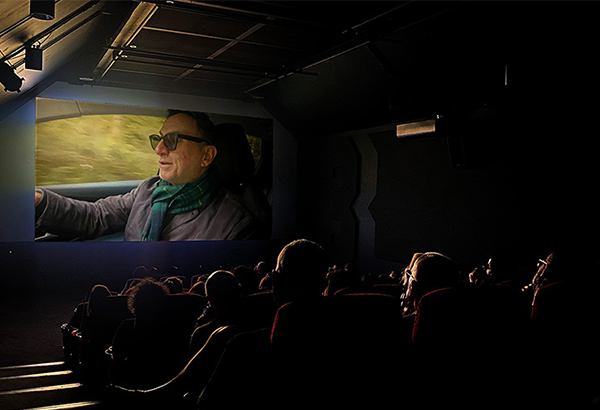
After a career on the other side of the lens, fashion photographer Philip Sinden turns the camera on himself during the search for his biological parents. The result, A Portrait of my Parents, is heartfelt, amusing and moving.
‘It was a stylistic choice to not make anything look good,’ explains Philip Sinden. ‘In my line of work, we’re faking things a lot.’ He is perhaps downplaying the visual merit of the documentary he has made, yet one of A Portrait of my Parents’ most striking qualities is indeed how stripped back it is. The camera is uneven. The shots wander. You see a lot of his car and his flat and his face from the awkward perspective of an outstretched arm. The informality only adds to the authenticity.
This is largely because the film follows Sinden on a journey he would be making with or without the audience. It’s a journey difficult for most of us to imagine, one that began over 50 years ago, when he was adopted by a religious family in North London. It did not seem an unhappy childhood, but the film hints at a certain melancholy and austerity, not least through the struggles of his adoptive mother, who suffered from Multiple Sclerosis.
Sinden still calls North London home, and while he was born here prior to his adoption, his biological parents came from further afield. Some of this he knew already. He had a name for his mother on the adoption paperwork, and he knew his father was Pakistani. From this vague provenance, Sinden set sail.
He did so with his friend, the author and poet Lemn Sissay, who was also separated from his biological parents. Rather than be adopted, Sissay spent his childhood in foster homes, bouncing around the care system through his teenage years. He adds a lot to Sinden’s A Portrait of my Parents, at first through his empathy and humor, then through his sizable social media following and finally through his and Sinden’s contrasting methods for tracking down families that may or may not want to be found.
The first half of the film focuses on the maternal side of the family. There is more information here, and, without wanting to give too much away, there are more answers. Sinden heads to Scotland and finds, after a bit of work, a family who seem as happy to find him as he does to find them. Uncle Sonny, in particular, takes a starring role, encapsulating so many of the film’s best qualities: sincerity, humor and a slight awkwardness that must invariably come with matters of the heart and estrangement.
Other than Sissay, the other friend enlisted is actor and director Dexter Fletcher. A schoolmate of Sinden’s, the pair grew up frequently playing together and visiting each other’s houses. Fletcher appears in an unusual interview, dropped in around the halfway point, in what at first feels a little heavy-handed but gradually ties the film together as Fletcher opens up. For this friendship not only adds context on the early years of Sinden’s life and an outside perspective on what his adoptive parents were like, but addresses some of the prickly and confusing questions that come with adoption, particularly as a child.
Then the attention turns to Pakistan and the search for Sinden’s father. This is a much more complicated process, with Sinden and Sissay piecing together fragments of names and dates. For a long time, it appears as if it will be fruitless, with rumblings of a pop-star half-brother, and a second cousin who may or may not know the man in question, being the main leads. In the end, they make headway, though this half of the story seems to still be unfolding, and with Sinden admitting A Portrait of my Parents remains ‘a work in progress’ and ‘unfinished’, it is tempting to hope that it could gain a further dimension through his biological father’s family.
If that never comes, A Portrait of my Parents is already a fully formed journey. Sinden found what he was looking for. Clarity, photos, names and siblings have all come into his life as a result of his great leap into a murky unknown, and as he wonderfully puts it, ‘The answers provided more life rather than closing doors.’
All imagery courtesy of the artist.