


Jenn Hernandez and Jocast Samuels fight for greater youth and female representation in global politics
“To shape the future, you cannot shape it from the past,” said Susanna Malcorra, President and Co-founder of GWL Voices and previous foreign minister of Argentina. “Not only do young people need to be sitting at the table, they need to shape the table.”
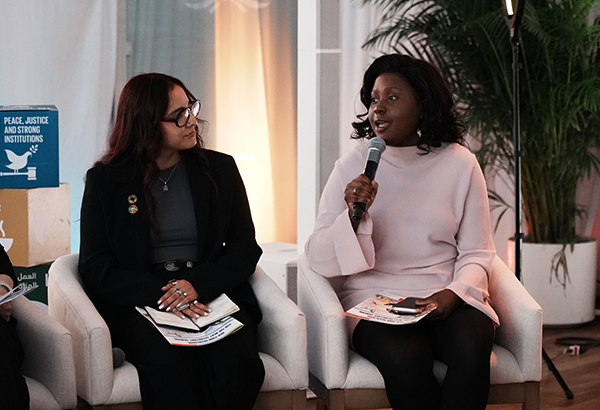
During the peak of High-level week at the United Nations, a diverse group of women came together for a panel organized by the United Nation’s SDG Media Zone. The talk titled “The Kind of Leader the World Needs Now” was moderated by Mission Magazine’s Founder and Editor-in-Chief, Karina Givargisoff, and featured GWL Voices founders Irina Bokova, Helen Clark, and Malcorra; along with Ugochi Daniels, Deputy Director General for Operations, IOM; Nyaradzayi Gumbonzvanda, UN Women Deputy Executive Director for Normative Support, UN System Coordination and Program Results; Global Network of Women Peacebuilders (GNWP) and Her Turn representative, Jenn Hernandez, and Girl MOVE Policy and Innovation Specialist, Jocast Samuels.
In a 2021 survey of 16-25-year-olds in 10 countries, 56% of respondents agreed with the statement, “Humanity is doomed,” in context with the climate crisis. The pessimism defining Gen Z has only continued to further with environmental decline, monumental legislative rulings, and overseas wars. Though, when addressing the audience, Clark reflected, “We’re all prisoners of hope.” She continued, “I think what keeps everyone going is the knowledge that the problems may be of long duration but they are solvable, and we need to bring the best minds across generations and regions and gender to do that.”
According to data from the UN System Chief Executives Board for Coordination, the median age of personnel in 2025 was about 47 years old. UN Women Data also reported that “[a]t the current rate, gender equality in the highest positions of power will not be reached for another 130 years.”
Despite the obstacles they face as young women in policy, Hernandez and Samuels stand out as committed leaders addressing the problems of today.
For Hernandez, the type of leader the world needs right now is “someone who is courageous enough to be different and stray from the status quo.”
“We have a system that was built 80 years ago, and we are no longer in 1942,” Hernandez says. “This leader needs to hold institutions, member states, and people accountable for their responsibilities in attributing to some of the world’s largest crises.”
She added that leadership doesn’t only entail its traditional meaning as the top of an organization. “Some of the most meaningful leadership happens at the community level, where women, young people, and civil society are already finding solutions to the challenges affecting their communities. We need someone that recognizes that our young people are losing hope for a better tomorrow.”
Hernandez added that youth involvement is crucial to make change into tangible outcomes. “There are not enough youth in decision-making positions and that needs to change sooner rather than later, especially youth that are Indigenous, LGBTQIA+, disabled, women, and people of color. Youth are tired of being told that we are too naive, too young, and too inexperienced,” Hernandez says.
Her work with GNWP has greatly impacted her outlook on the importance of supporting youth involvement and diversity at a leadership level within global governance. “Youth leadership is also about investing in young people for the long term. If we want young people to take on leadership … then we need to give them the opportunities to develop the skills, networks, confidence, and resources to do so.”
For other young people today, Hernandez advises, “It’s going to be scary, the fear does not go away, but to continue to do things that make you uncomfortable. Do it scared. Do it tired. Just as long as you do it.”
In the face of discomfort and fear, Samuels took up the responsibility to enact change in her own community. After a politically and socially tense time in Mozambique, Samuels was undergoing a “leadership journey” with Girl MOVE Academy. She asked herself, “Am I going to remain a spectator of these systems, or am I going to learn enough to contribute to them?”
Following this revelation, Samuels has worked alongside the Girl MOVE Academy team to promote education of girls and young women across Mozambique. Mentioned in the panel, Girl MOVE Academy had the opportunity to coordinate with the nation’s Ministry of Education to expand their work throughout the country. The program now operates in Cabo Delgado,Nampula, Zambézia and Sofala, bringing together over 10,000 mentors and mentees.
From this experience, Samuels learned that “innovation only becomes lasting change when public institutions can own it.”
Through her work with young people, Samuels has noticed a “growing appetite … to participate, to organise, to debate, to engage institutions and to see themselves as actors in the country’s direction.” Though, she argues, “Representation is only the beginning. Representation without influence is not enough.”
She warns, “Too often … intergenerational dialogue can become a space where young people bring energy, older generations bring experience, and power remains exactly where it was. Trust begins when both sides are willing to risk something.”
In addressing her own generation, Samuels says, “The responsibility is not simply to enter rooms that were previously closed to us. It is to help build the capacity, relationships and institutions that allow more people to enter those rooms and contribute meaningfully when they do.”
Reflecting upon the future, she adds, “Perhaps that is what paying it forward ultimately means: not leaving the next generation the responsibility of beginning where we began, but giving them foundations from which they can begin further ahead.”
Homepage image Photos courtesy of Girl MOVE Academy. Inside image, left, Jenn Hernandez and right Jocast Samuels. Photos courtesy of GWL Voices.